
Los Angeles to Las Vegas: Distance, Drive Time, and the I-15 Desert Haul
About 270 miles via I-15 through the Mojave — usually 4 to 5 hours when traffic cooperates, longer when Cajon Pass Fridays and Primm Sundays rewrite the weekend.
Los Angeles to Las Vegas is the desert haul SoCal treats as a birthright until Friday at Cajon Pass proves that 270 miles and four hours only live on the brochure.
I-15 north climbs out of the basin, clears the San Bernardino and San Gabriel mountain walls at roughly 3,777 feet, then drops into Mojave heat that can rewrite range, tire pressure, and patience before Baker’s thermometer even appears on the horizon.
Chinese American, Korean American, Filipino, and South Asian families across the San Gabriel Valley, Orange County, and the Inland Empire do this run for conventions, milestone birthdays, fight weekends, and the buffet nobody admits they booked. The car needs cold tires, water, and a fuel or charging plan before Victorville — not a hope that Primm will be cheap and empty.
Leave Thursday night or Saturday before dawn and I-15 feels almost manageable. Leave Friday at 4 p.m. and Baker becomes a lifestyle. The corridor is won on departure timing and one honest stop, not on finding a secret alternate freeway.
Distance and drive time
- How far is Los Angeles from Las Vegas?
Most mapping tools put downtown Los Angeles to the Las Vegas Strip at about 270 miles on I-15 north — the only route most weekend drivers seriously consider.
Where you start in the basin matters more than the Strip end: Santa Monica and the Westside push toward 285–290 miles, while Anaheim, Pasadena, or an Inland Empire departure (Ontario, Riverside, Rancho Cucamonga) can trim 20–40 miles before you ever see Cajon Pass.
- ·Red Rock Canyon west of the Strip adds roughly 15–20 miles once you leave I-15.
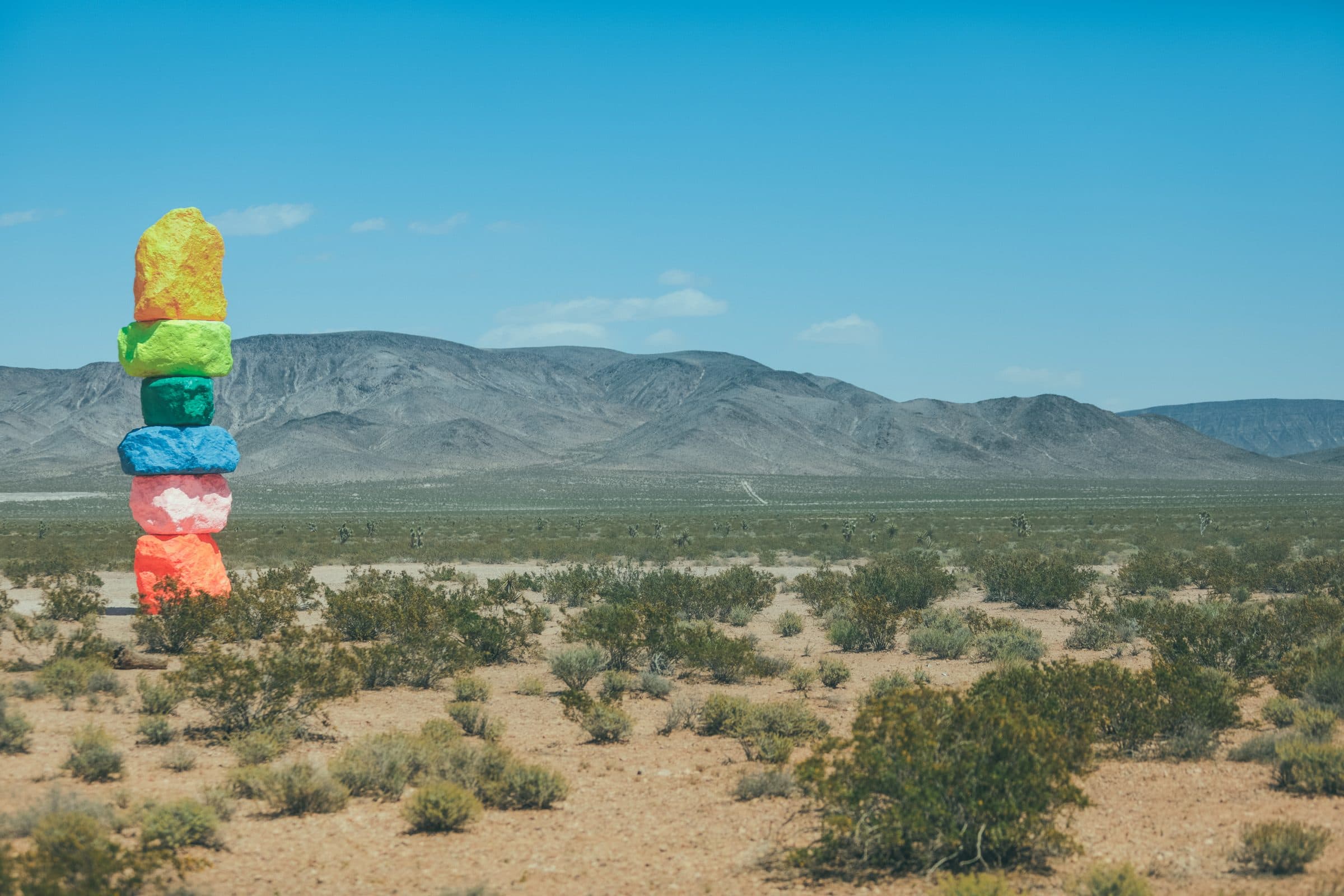
- ·Seven Magic Mountains sits just off the corridor south of Las Vegas — minutes, not a day trip.
- How long does it take to drive from LA to Las Vegas?
Pure highway time with light traffic usually lands near 4 to 4.5 hours once you clear the LA freeway maze. Door-to-door with a Baker stretch, Strip garage hunt, and normal weekend volume often becomes 5 to 6 hours.
Cajon Pass sets the Friday mood: northbound backups regularly build from early afternoon through evening. Sunday returns stack southbound at Primm and the California agricultural inspection area near Mountain Pass, where three Nevada lanes compress toward two California lanes.
- ·Caltrans QuickMap (quickmap.dot.ca.gov) is the live check before you commit — cameras, incidents, and chain controls.
- ·Major Vegas weekends (EDC, big fights, holiday conventions) can double the usual Friday/Sunday delay.
- What is the best route from LA to Las Vegas?
I-15 is the spine. You climb Cajon Pass (about 3,777 feet at the summit), drop into the Victor Valley, pass Barstow’s fuel-and-charging hub, then run the long Mojave middle through Baker before the Nevada line at Primm.
Old US-91 nostalgia routes exist on maps. They rarely beat I-15 for time, and they trade services for empty desert — fine for a photo afternoon, poor as a Friday night plan.
- ·Fastest: I-15 north with one planned Barstow or Baker reset.
- ·Scenic arrival add-on: Seven Magic Mountains from I-15 near Jean/Sloan, or Red Rock Canyon west of the Strip with a timed-entry reservation in peak months.
- Where should you stop on the LA to Vegas drive?
Barstow is the practical desert hub — outlets, restaurants, and large Tesla Supercharger sites that now serve many non-Tesla EVs with the right adapter. Baker is the cultural midpoint: the 134-foot World’s Tallest Thermometer, Alien Fresh Jerky, and Mad Greek Cafe lines that look ridiculous until you have been in the car for three hours.
Chinese American, Korean American, Filipino, and Vietnamese households across SoCal often treat Spring Mountain Road — Las Vegas Chinatown — as the real arrival dinner. The corridor was master-planned around Chinatown Plaza in the mid-1990s and later designated as a three-mile Chinatown district; today it is pan-Asian dining west of the Strip, not a historic enclave.
- ·Barstow stop — 20–40 minutes.
- ·Baker thermometer / Mad Greek — 30–45 minutes.
- ·Seven Magic Mountains — 20–40 minutes.
- ·Spring Mountain Road dinner — 60–90 minutes.
- Is the LA to Vegas drive safe in summer?
Baker sits near 940 feet elevation at the southern end of the Death Valley depression. Summer highs regularly clear 110°F; local history still points to the Death Valley 134°F record that inspired the town’s giant thermometer. AAA Nevada flags batteries, cooling systems, and underinflated tires as the breakdown trio in desert heat.
Carry water for every passenger. NPS guidance for Mojave travel starts at about one gallon per person per day for vehicle trips — more if anyone will walk or you expect a roadside wait. Check cold tire pressures to the door-jamb placard before you leave; do not bleed air from hot tires at a Baker pump.
- ·Never let the fuel tank or battery fall into the empty middle of the Mojave on optimism alone.
- ·Winter still matters: Caltrans can set chain controls on I-15 over Cajon Pass when snow or ice warrants it — verify QuickMap before storms.
- Is Los Angeles to Las Vegas easy in an EV?
At roughly 270 miles of sustained highway, many long-range EVs can do the corridor with a single DC top-up if you leave SoCal near full. AAA’s recent temperature testing found about an 8.5% average BEV range loss at 95°F versus a 75°F baseline — smaller than winter’s hit, but still real before you add hard air conditioning and sustained speeds above 70 mph.
Barstow’s Main Street Tesla Supercharger site lists on the order of 120 stalls; the Outlets at Barstow site adds dozens more. Baker now has a large Mojave Pointe Supercharger hub (on the order of 40 stalls, opened 2025) plus Electrify America CCS options on Baker Boulevard. Verify live status the night before — Friday evenings create queues even at big sites.
- ·Start above ~90% unless you already have a reserved Barstow stop in the plan.
- ·Run our EV vs gas road trip calculator with desert heat and highway-speed assumptions before the household argues hybrid versus EV.
I-15 stops worth planning
Approximate progression north from the LA basin. Confirm charger status, park hours, and Red Rock timed entry before you detour.
LA basin to Cajon Pass (~0–60 miles)
Getting to I-15 north is half the SoCal game — I-10, CA-60, and the Inland Empire merges decide whether you meet Cajon climbing or already crawling. High-profile vehicles feel the pass’s wind; Caltrans message boards warn when Santa Ana gusts get serious.
Once you commit to the climb, services thin relative to the basin. Fuel or charge with margin before the grade if you are already low.
- Inland Empire join (Ontario / Rancho Cucamonga). Shorter start than the Westside — often the smartest departure for IE households.Recommended time: Build 20–40 min buffer for Friday afternoon merges
- Cajon Pass summit area. About 3,777 feet — grades, runaway-truck ramps, winter ice risk, summer tire stress.Recommended time: Drive through; pull out only for a safe viewpoint
Victor Valley to Barstow (~60–140 miles)
Victorville and Apple Valley are the first real high-desert reset after the pass — fuel, food, washrooms, and a chance to cool the cabin before the longer Mojave stretch.
Barstow is the corridor’s utility capital: outlets shopping, chain restaurants, and the densest DC fast charging until you reach Las Vegas proper.
- Victorville / Apple Valley exits. First major reset after Cajon — useful if the pass ate your buffer.Recommended time: 15–25 minutes
- Barstow outlets / Main Street charging hub. Fuel, food, and large Tesla Supercharger sites (Main Street on the order of 120 stalls; Outlets site also substantial) — common EV stop.Recommended time: 25–45 minutes
- Calico Ghost Town (optional detour). San Bernardino County park near Yermo off I-15 — silver-mining tourist town rebuilt for visitors. Worth 1.5–2 hours, not a quick photo stop.Recommended time: 90–120 minutes if touring
Mojave middle: Baker (~140–200 miles)
This is the loneliest stretch most drivers remember. Baker’s population is a few hundred people; the economy is almost entirely I-15 traffic, truckers, and Death Valley gateway travelers.
Summer heat here is not a metaphor — highs routinely exceed 110°F. Carry water, keep the cabin cool before it feels urgent, and treat a half tank or mid-battery as a reason to stop, not a dare.
- World’s Tallest Thermometer. 134-foot roadside sign commemorating Death Valley’s 134°F record (July 10, 1913). Visible for miles; gift shop at the base.Recommended time: 10–20 minutes for photos
- Mad Greek Cafe / Alien Fresh Jerky strip. The classic Baker food stretch — long lines on Sunday returns are normal.Recommended time: 30–45 minutes
- Baker DC charging (Mojave Pointe / Baker Blvd). Newer Tesla Supercharger hub on Mojave Pointe plus Electrify America CCS options on Baker Boulevard — verify live stalls.Recommended time: 25–40 minutes
Primm to Las Vegas arrival (~200–270 miles)
Primm marks the Nevada approach — casinos, expensive fuel relative to the Strip, and the Sunday southbound bottleneck when California-bound traffic compresses. Caltrans operates a part-time shoulder travel lane on southbound I-15 near the state line on busy Sundays and Mondays (typically 10 a.m.–8 p.m. when active) to ease the three-to-two lane squeeze; always follow posted signs.
Seven Magic Mountains sits in Ivanpah Valley just off the corridor — free BLM-managed public art by Ugo Rondinone, roughly 30–35-foot day-glo boulder towers. Sunrise to sunset is the practical visit window; no restrooms on site.
- Seven Magic Mountains. Neon stacked-boulder installation south of Las Vegas — Travel Nevada and the project site document I-15 exits via Jean or Sloan / Las Vegas Boulevard.Recommended time: 20–40 minutes
- Welcome to Fabulous Las Vegas sign. Classic photo stop on Las Vegas Boulevard south of the Strip — shorter lines on weekday mornings.Recommended time: 15–25 minutes
- Chinatown Las Vegas (Spring Mountain Road). Pan-Asian dining corridor west of the Strip — KBBQ, dim sum, Vietnamese, Filipino, late-night noodles away from tourist pricing.Recommended time: 60–90 minutes for dinnerSoCal region guide →
Pro Tips
Consider these extra good-to-knows to make the most of your trip.
Weekend casino / convention households
- ·Thursday after 8 p.m. or Saturday before 6 a.m. beats Friday 2–8 p.m. Cajon northbound
- ·Hotel garage included with the booking — Strip self-park hunts erase your buffer
- ·Fuel in metro Vegas or Barstow; Primm and Jean often price like a border tax
- ·Sunday return: leave before 9 a.m. or after 6 p.m. to miss the Primm stack when you can
Family buffet and birthday trips
- ·Plan Baker as a hard stop — washrooms and AC reset matter more than the thermometer photo
- ·Pack water before Victorville; do not wait until someone feels dizzy
- ·Motion-sensitive passengers prefer Barstow food over eating while the car climbs Cajon
- ·Spring Mountain Road dinner often calms multigenerational groups better than a Strip buffet line
EV corridor drivers
- ·Barstow DC first choice; Baker as backup or midpoint if you left below 90%
- ·Expect slower DC sessions when the battery is thermally busy in 100°F+ ambient
- ·Confirm Magic Dock / NACS adapter needs before you treat Tesla lots as universal
- ·Hotel destination charging is a booking question — Strip circling burns buffer
Scenic / photo weekend
- ·Seven Magic Mountains on arrival before Strip fatigue sets in
- ·Red Rock Canyon scenic drive needs timed entry Oct 1–May 31 (8 a.m.–5 p.m.) via Recreation.gov — $20/vehicle typical day fee
- ·Do Red Rock in morning light; save Spring Mountain Road for dinner
- ·Skip Calico if Red Rock is already on the card — one desert museum day is enough
Which car should you take?
This corridor rewards cooling systems, tire condition, and cabin calm over horsepower theater — four hours of I-15 is a comfort test.
| Trip personality | Bring (or rent) | Why |
|---|---|---|
| Convention weekend sprint | Efficient sedan or crossover with easy garage parking | Hotel ramps and Strip navigation punish oversized trucks |
| Family buffet trip | Three-row SUV or minivan energy | Kids, luggage, cooler, and elder second-row comfort |
| Desert heat realist | Hybrid crossover with strong AC and fresh coolant | AAA’s desert advice starts with cooling and tires — hybrids skip charger queues |
| EV overnight | Long-range EV with Barstow/Baker DC plan | Corridor charging is real now — heat and highway speed still need margin |
Pick your version of the drive
Same I-15, different weekends. Pick the version that matches buffet timing, art photos, or a Red Rock morning before anyone opens Maps in the car.
The Direct I-15 Sprint
I-15 north with one Barstow or Baker reset, straight to the hotel garage. Best when registration opens early or the dinner reservation is already tight.
Thermometer photos only if the passengers revolt. Save Seven Magic Mountains for the Sunday return if daylight remains.
- →Barstow fuel or DC — 20–30 min
- →Optional Baker stretch — 15–20 min
- →Hotel garage check-in
The Art-and-Chinatown Arrival
Hit Seven Magic Mountains before Strip sensory overload, then dinner on Spring Mountain Road.
Ideal for households that care more about photos and noodles than an immediate casino floor.
- →Baker Mad Greek or jerky stretch
- →Seven Magic Mountains — 20–40 min
- →Spring Mountain Road dinner — 60–90 min
The Red Rock Side Trip
Detour west to Red Rock Canyon National Conservation Area for the 13-mile one-way scenic drive (about 45 minutes without stops; longer with pullouts).
BLM timed entry applies October through May for peak daytime hours — book Recreation.gov before you leave SoCal. Better as a Saturday morning than a Friday night arrival.
- →Hotel drop bags first if possible
- →Red Rock scenic drive — 2–3 hours with short walks
- →Spring Mountain Road or Strip dinner
Stops worth knowing
Real places along the corridor. Hours change; always check before you detour.
World’s Tallest Thermometer
134-foot roadside landmark — the unofficial halfway photo.
- →Visible from I-15
- →Gift shop at base
- →Pairs with Mad Greek
Seven Magic Mountains
Free day-glo boulder towers by Ugo Rondinone on BLM land.
- →Sunrise–sunset visit window
- →On-site parking lot
- →No restrooms
Spring Mountain Road (Chinatown)
Pan-Asian dining corridor — the arrival dinner many SoCal households actually want.
- →KBBQ and noodles
- →Away from Strip parking chaos
- →Late-night friendly
Red Rock Canyon Scenic Drive
13-mile one-way loop — sandstone contrast after I-15 monotony.
- →Timed entry in peak months
- →$20/vehicle day fee typical
- →Morning light preferred
EV notes for Los Angeles to Las Vegas
I-15 is no longer an empty charging desert. Barstow and Baker both support serious DC fast charging, and Las Vegas has dense destination options once you arrive. The remaining failure mode is optimism: leaving SoCal at 70%, running 80 mph with the AC on max, and assuming Baker’s stalls will be free at 7 p.m. Friday.
AAA’s 95°F testing puts average BEV range loss near 8.5% versus mild weather — then highway aerodynamics and cabin cooling stack more loss on top. Plan one DC stop as default for packs under roughly 300 miles of rated range; treat two stops as insurance if you start soft or travel in peak heat.
Many SoCal households still take the hybrid or gas car for Vegas weekends because buffet timing beats charger queues. That is a legitimate preference — run the calculator with your actual overnight plan rather than arguing from brochure range.
Compare fuel vs charging on this desert haul
Baker heat and highway speeds change the math — run your miles before the household picks the weekend car.
The bottom line
Los Angeles to Las Vegas is won on departure timing, a Barstow or Baker reset, and respect for Mojave heat — not on finding a clever alternate to I-15.
Treat Cajon as the Friday gate, Primm as the Sunday gate, Spring Mountain Road as the dinner that feels like home, and Caltrans QuickMap as mandatory reading before every holiday weekend.