
Peninsula and South Bay Car Ownership: 101, 280, 880, Caltrain and the Right Vehicle for the Household
How Peninsula, San Jose, and Fremont households can combine 101, 280, and 880 commute vectors with Caltrain, VTA, BART, home or workplace charging, and the right compact, crossover, EV, or family vehicle.
Key numbers for Peninsula and South Bay Car Ownership
- Work within Santa Clara County
- 87%
- Share of employed Santa Clara County residents whose jobs are also in the county, according to MTC-ABAG Vital Signs commute-pattern data.
- Caltrain FY2025 growth
- +47%
- Ridership increase following the September 2024 launch of electrified mainline service.
- Caltrain local end to end
- 77 min
- Scheduled San Francisco-to-San Jose local time after electrification, reduced from 100 minutes. Station-pair times vary.
- VTA monthly pass
- $90
- Adult calendar-month bus and light-rail pass in 2026. The annual subscription provides 12 months for the price of 11.
- Santa Clara median income
- $164,281
- Median household income in 2024 dollars for the Census Bureau's 2020–2024 period.
- San Mateo median income
- $158,855
- Median household income in 2024 dollars for the Census Bureau's 2020–2024 period.
- San Jose household size
- 2.97
- People per household in San Jose during 2020–2024, useful context for passenger and cargo testing.
- Fremont Asian population
- 63.8%
- Asian alone share in the Census Bureau's 2020–2024 data, audience context rather than a vehicle-choice shortcut.
Build three maps before choosing a car
A Peninsula or South Bay household needs three maps. The first shows where adults work. The second shows where children, relatives, schools, medical appointments, and weekly errands sit. The third shows where each vehicle can reliably charge or refuel. US-101, I-280, and I-880 connect different employment centers, airports, bridges, and neighborhoods, so a shared county name cannot describe the daily trip.
Caltrain can replace a commute that follows its spine. VTA can connect selected San Jose, Santa Clara, Mountain View, Milpitas, and Campbell trips. BART can remove an East Bay leg for Fremont or Milpitas households. Employer shuttles may close the gap between a station and campus. Each option still needs a test against daycare pickup, elder care, late shifts, and the final mile.
Start with a seven-day calendar. For every recurring trip, record origin and destination, departure window, passenger needs, cargo or child-seat requirements, 101, 280, 880, or bridge exposure, a practical rail or bus alternative, parking cost, and charging control. A household can then identify which trips reliably leave the car at home before financing a second vehicle.
Define each vehicle's job in one sentence: solo 101 commuter, cross-bay family carrier, station-access car, or one household vehicle for every trip. That sentence creates a stronger shortlist than starting with a badge or body style. A one-car household should optimize the hardest weekly trip and rent for rare extremes. A two-car household should diversify roles.
Fremont is geographically in the East Bay, but its Dumbarton, I-880, SR-237, BART, and South Bay employment patterns justify its inclusion here alongside Newark and Milpitas. The guide covers San Mateo County, Santa Clara County, and those commute-linked communities. Regional toll formulas belong in the Bay Area commute-cost guide; San Francisco curb rules belong in the city ownership guide.
High median income provides context rather than permission to ignore fixed costs. Santa Clara County's 2020–2024 median household income was $164,281 and San Mateo County's was $158,855. Every household still benefits from direct insurance quotes, realistic tire and maintenance reserves, and a Car Affordability Calculator result that includes parking and charging equipment.
101, 280, 880, and transit as car-count tools
US-101 is the bayside employment and airport spine. It connects SFO, South San Francisco, San Mateo, Redwood City, Palo Alto, Mountain View, Sunnyvale, Santa Clara, and San Jose, while SR-92 and SR-84 feed cross-bay trips. Express lanes run between I-380 and North Mathilda Avenue in Sunnyvale with a connected southbound SR-85 segment. They operate from 5 a.m. to 8 p.m. on weekdays.
Solo drivers pay the displayed US-101 toll with FasTrak. A two-person carpool pays half price with a FasTrak Flex tag set to 2. Three-person carpools, qualifying vanpools, and motorcycles travel free with the appropriate setting. Former Clean Air Vehicle decals no longer provide solo access. Long trips can accumulate charges through multiple zones, so households should review real transactions rather than assign one price to the corridor.
A short local 101 commute rewards compact dimensions and efficient stop-and-go operation. A longer trip makes seat comfort, tire noise, climate control, and adaptive-cruise behavior more important. An EV can suit predictable mileage when overnight charging is controlled. A hybrid remains resilient when charging depends on an apartment or employer.
I-280 runs along the western Peninsula before entering San Jose. It serves western San Francisco approaches, Daly City, San Bruno, hillside communities, Stanford-area access, Cupertino, and west San Jose. It has fewer direct exits to many bayside campuses, and a long surface-street connection can erase an apparent advantage. Use 511 and Caltrans QuickMap rather than assuming 280 is always faster.
Long grades and highway speeds on I-280 expose tire noise and aerodynamics. An EV buyer should examine real highway consumption rather than apply a city-efficiency figure to every commute. A hybrid shopper should check highway fuel economy and seat comfort. Valuable but constrained garages also make exterior width and approach angle meaningful purchase criteria.
I-880 connects Oakland, San Leandro, Hayward, Fremont, Milpitas, and San Jose. Freight traffic and long urban segments make ride quality, driver assistance, and noise daily ownership issues. Express lanes operate southbound from Hegenberger Road to Dixon Landing Road and northbound from Dixon Landing Road to Lewelling Boulevard from 5 a.m. to 8 p.m. on weekdays.
The I-880 occupancy rules mirror 101: solo drivers pay full price, two-person carpools pay half price with Flex set to 2, and three-person carpools travel free with Flex set to 3+. Income-qualified drivers may be eligible for Express Lanes START; its status and qualification rules should be checked immediately before publication. SR-237 links Milpitas, North San Jose, Sunnyvale, and 101 under a similar lane structure.
Fremont and Newark households working on the Peninsula should compare the Dumbarton Bridge with I-880 and SR-237 approaches and, farther north, the San Mateo-Hayward Bridge. Both bridges collect westbound tolls. A recurring crossing shapes the vehicle plan even though the exact monthly arithmetic belongs in the commute-cost guide.
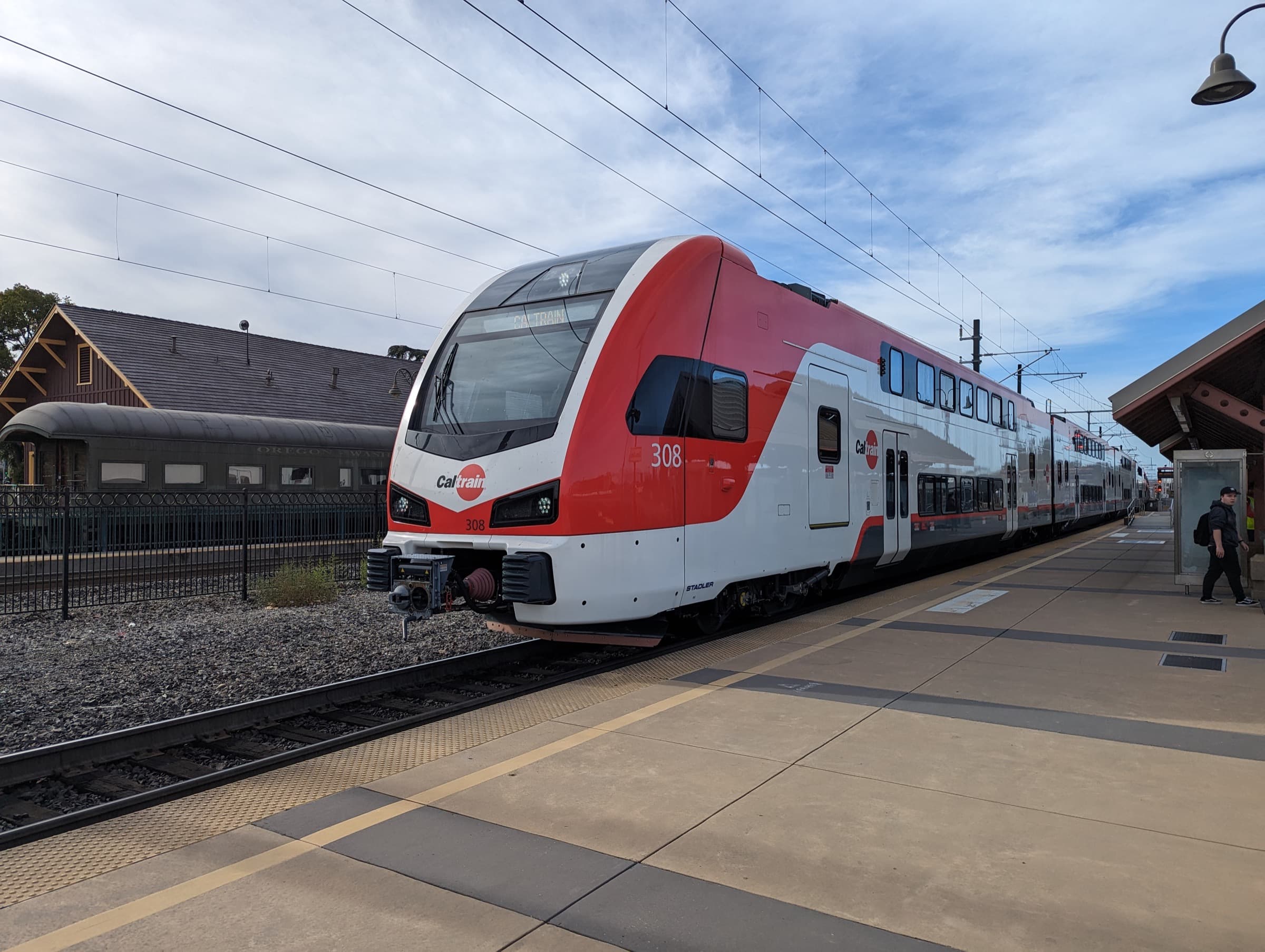
Caltrain's electric mainline service launched in September 2024. FY2025 ridership rose 47% from FY2024, and ridership from October 2024 through June 2025 was 52.5% above the same months a year earlier. Weekend use approximately doubled after frequency increased. The scheduled local trip from San Francisco to San Jose fell from 100 to 77 minutes, while express service can complete the end-to-end trip in under an hour.
The useful number is still the current time between the household's stations. Compare Local, Limited, and Express service, the first mile, station parking, the final campus connection, late-meeting options, and school or caregiver responsibilities. A three-day hybrid worker should test stored-value fares against the monthly pass rather than assume a five-day pattern.
VTA's adult monthly pass costs $90 in 2026 and covers bus and light rail. Its annual subscription offers 12 consecutive monthly passes for the price of 11. VTA recorded 4,485,965 light-rail boardings in 2025, though the March labor action materially reduced the annual total. BART stations at Warm Springs/South Fremont, Milpitas, and Berryessa/North San Jose can remove an East Bay leg, subject to first- and last-mile reality.
How the Peninsula and South Bay break down
Each area combines a distinct freeway vector, rail option, charging pattern, and household use case. These are planning modules rather than vehicle rankings.
Daly City, South San Francisco, and San Bruno
These communities combine fog, hills, SFO access, BART, Caltrain, and both 101 and 280 commute choices.
- ·A compact crossover or hybrid can handle airport and family duty without unnecessary garage width
- ·An EV works with driveway or assigned charging; public dependence can reverse the answer
- ·Test the real office interchange and station connection before assigning a commute route
San Mateo, Burlingame, Belmont, and Redwood City
Caltrain access can reduce the household's car count, while SR-92 creates a recurring bridge vector for East Bay work or family.
- ·A station-adjacent household may need one flexible weekend vehicle rather than two commuters
- ·Compare compact luxury crossovers with loaded mainstream hybrids after insurance and tires
- ·Measure garages and first-mile station access before choosing exterior size
Menlo Park, Palo Alto, Mountain View, Sunnyvale, and Cupertino
Caltrain, campus shuttles, 101 express lanes, expensive garage space, and high EV adoption create several plausible one-car and two-car plans.
- ·Treat workplace charging and employer shuttles as benefits that can change
- ·A premium EV needs durable home charging, an insurance quote, tire acceptance, and service access
- ·A compact EV or hybrid can complement an existing family vehicle without duplicating its role
San Jose and Santa Clara
The market ranges from rail-served urban neighborhoods to long suburban school and family circuits across 101, 280, 680, 880, and SR-87.
- ·San Jose's 2.97-person average household supports practical passenger and cargo testing
- ·Test a minivan, midsize three-row, and two-row hybrid with actual relatives, seats, and luggage
- ·A compact commuter plus an occasional rental may beat a large vehicle used mostly solo
Fremont, Newark, and Milpitas
Dumbarton and San Mateo bridge exposure, I-880 and SR-237, BART, South Bay jobs, and home charging shape the household fleet.
- ·Map both adults' commutes independently rather than assuming two cars share one route
- ·A home-charged EV plus efficient hybrid can diversify energy and trip roles
- ·Fremont's 63.8% Asian population is audience context and should never become a vehicle stereotype
Morgan Hill and Gilroy
Outer South Bay households face longer mileage and less frequent Caltrain service south of Tamien.
- ·Energy cost, highway comfort, and schedule resilience deserve extra weight
- ·A home-charged EV or efficient hybrid is easier to defend than public-charging dependence
- ·Check current Caltrain service by station and day instead of using an end-to-end average
Choose the vehicle class after defining the job
Compact hybrid or compact EV
- ·A compact hybrid is a resilient default for uncertain charging and mixed freeway and city use
- ·A compact EV fits predictable mileage with controlled overnight charging
- ·Compare efficiency, insurance, tire replacement, and service access rather than acceleration alone
Small crossover
- ·Adds easier child, elder, and cargo access while remaining manageable in Peninsula garages
- ·Choose AWD for a repeated need rather than one occasional Tahoe trip
- ·Test mirror width, turning path, rear-door access, and liftgate clearance
Minivan or three-row crossover
- ·A minivan earns its footprint when six or seven people, several child seats, or bulky family logistics recur
- ·Test a three-row crossover with actual passengers and inspect cargo space with the third row raised
- ·Sliding doors may be more useful than SUV styling in narrow family parking spaces
Premium EV
- ·Require secure home charging, a direct insurance quote, tire-cost acceptance, and practical service access
- ·Compare with a loaded mainstream EV or hybrid before treating the badge as the default
- ·Recheck utility tariffs and household charging control before committing to a long loan
Four household fleet plans
Redwood City couple with one Caltrain commute
One adult uses Caltrain while the other retains a flexible household car. Compare the arrangement with two payments, insurance policies, and parking spaces. A compact hybrid or EV crossover can cover remaining errands and weekends while station access shapes the weekday plan.
Fremont household with two South Bay jobs
Map both destinations, bridge crossings, and rail options. One home-charged EV can absorb predictable mileage while an efficient hybrid covers schedule changes, cross-bay family trips, and charging interruptions. Avoid buying two vehicles around one assumed route.
San Jose multigenerational household
Count regular passengers rather than maximum hypothetical passengers. Test elder access, child seats, and airport luggage in a minivan, midsize three-row crossover, and two-row hybrid. Choose the smallest class that passes the real weekly test.
Palo Alto apartment professional
Treat workplace charging as a benefit that may disappear after a job or office change. Favor a hybrid unless the lease or HOA provides durable home charging. A first premium EV should also clear direct insurance, tire, and service checks.
Rank charging by household control
A household-owned driveway circuit provides the strongest foundation. An HOA-approved or lease-backed installation can also be durable. Workplace charging remains tied to an employer, office location, access policy, and price that may change. Routine public charging gives the household the least control.
PG&E's EV2-A residential rate applies to the home and vehicle on the same meter. Its lowest-price period runs from midnight to 3 p.m., peak hours run from 4 to 9 p.m., and partial peak covers the adjacent hours. It can suit households able to shift the vehicle and other large loads away from the evening peak.
Do not present one PG&E figure as the household's complete electricity price. Peninsula Clean Energy or Silicon Valley Clean Energy may supply generation while PG&E delivers the electricity. Compare the combined delivered rate, taxes, and any base charge. Then test the whole-home bill because a lower vehicle period can be offset by expensive household use at peak.
Calculate monthly charging as miles divided by miles per kWh, multiplied by the delivered off-peak price, with charging losses disclosed. A workplace charger may reduce that amount without becoming a secure basis for a vehicle loan. Ask what happens after a job change, a return-to-office policy shift, or the introduction of employee charging fees.
Peninsula Clean Energy's EV Ready program offers technical assistance and incentives for eligible apartment, condo, commercial, and public-agency projects, potentially including site review, load analysis, design, bidding, permitting, and rebate navigation. Program funding and eligibility should be checked before publication. The Bay Area Air District's FYE2025 Charge! round is closed and should not be described as current assistance unless a new solicitation opens.
Employee personal-vehicle chargers also carry accessibility obligations. The U.S. Access Board explains that the employee-work-area exception does not apply when chargers are provided for employees' personal vehicles. A workplace project therefore needs accessibility planning alongside power and parking decisions.
What to carry into the showroom
Design the household fleet before choosing models. Mark the trips Caltrain, VTA, BART, or employer transport can reliably remove. Then give each remaining vehicle one clear job: commuter, cross-bay family carrier, station-access car, or all-purpose household vehicle.
Choose the smallest class that completes that job with comfortable passenger, cargo, range, and charging margins. A one-car household should optimize its hardest recurring trip and rent for rare extremes. A two-car household gains resilience when an efficient commuter and flexible family vehicle have distinct roles.
Revisit the plan after a job change, school move, charger installation, utility tariff revision, or transit schedule change. High regional incomes describe the market; they do not make an unused second car or unnecessarily large vehicle affordable.
Related guides
- Northern California
- Bay Area Dealership Dossiers
- Toyota Sunnyvale Dossier
- Honda of Stevens Creek Dossier
- Lexus Stevens Creek Dossier
- Capitol Hyundai Dossier
- Capitol Kia Dossier
- Bay Area Commute Costs
- San Francisco Car Ownership
- Commute Cost Calculator
- Car Affordability Calculator
- Hybrid vs EV Monthly Calculator
- Public vs Home Charging
- Best Cars for Long Commutes
- Best Cars for Multigenerational Households
- Best EVs for Condo and Apartment Living
- First Luxury Car Guide
- Charging at Condos and Apartments
- San Francisco to Lake Tahoe
More NorCal driving guides
East Bay & Contra Costa Car Ownership
A practical guide to car ownership from Oakland and Berkeley to Walnut Creek and Livermore, covering theft, insurance, BART parking, supercommutes, heat, and family needs.
Seasonal preparednessSeasonal Driving: Tahoe, Wildfire & Rain
Prepare a Northern California car for Tahoe chain controls, wildfire smoke and evacuation, atmospheric-river flooding, wet-weather tires, and realistic EV energy buffers.
Culture & motorsportNorthern California Car Culture
A respectful guide to Northern California's JDM, tuner, lowrider, custom, museum, and motorsport communities from the Bay Area and Sacramento to Sonoma and Monterey.
Culture & placeMonterey Peninsula Car Culture
Why classic-car culture rooted on the Monterey Peninsula - from Del Monte Forest road races and the first Concours to Laguna Seca, auctions, and Car Week - plus how to drive and visit the towns year-round.
Commute costsBay Area Commute Costs
Price a real Bay Area commute across bridge tolls, FasTrak, express lanes, fuel, parking, insurance, BART, Caltrain, and VTA.
City ownershipSan Francisco Car Ownership
Decide whether a car earns its space in San Francisco through parking permits, garage fit, street rules, theft exposure, insurance, and charging.