
San Francisco Car Ownership: Parking, Garage Fit, Charging and the Point Where a Car Earns Its Space
A practical guide for San Francisco renters, condo owners, and homeowners deciding whether a car solves enough weekly trips to justify permits, garage constraints, street rules, theft exposure, insurance, and charging.
Key numbers for San Francisco Car Ownership
- Annual residential permit
- $224
- Passenger-vehicle residential parking permit effective July 1, 2026. A permit exempts a matching area time limit but does not reserve a curb space.
- Curb maximum
- 72 hours
- Maximum time a vehicle may remain in one place on a public street, including vehicles with residential permits or disabled placards.
- 2025 vehicle thefts
- 3,054
- Preliminary SFPD citywide motor-vehicle theft total, down 44% from 2024.
- 2025 thefts from cars
- 5,380
- Preliminary SFPD citywide theft-from-vehicle total, down 42% from 2024.
- Muni monthly pass
- $86
- Adult Muni-only monthly product in 2026, useful as a baseline before parking and vehicle costs.
- Muni plus SF BART
- $104
- Adult monthly pass covering Muni and BART trips within San Francisco in 2026.
- Studied building capacity
- 1–2 40A circuits
- Capacity found in many existing multi-unit buildings examined by the CEC-supported San Francisco charging project; broader readiness often required upgrades.
- Mean commute
- 30.4 min
- Mean commute for San Francisco workers age 16 and older in the Census Bureau's 2020–2024 QuickFacts period.
Begin with where the car sleeps
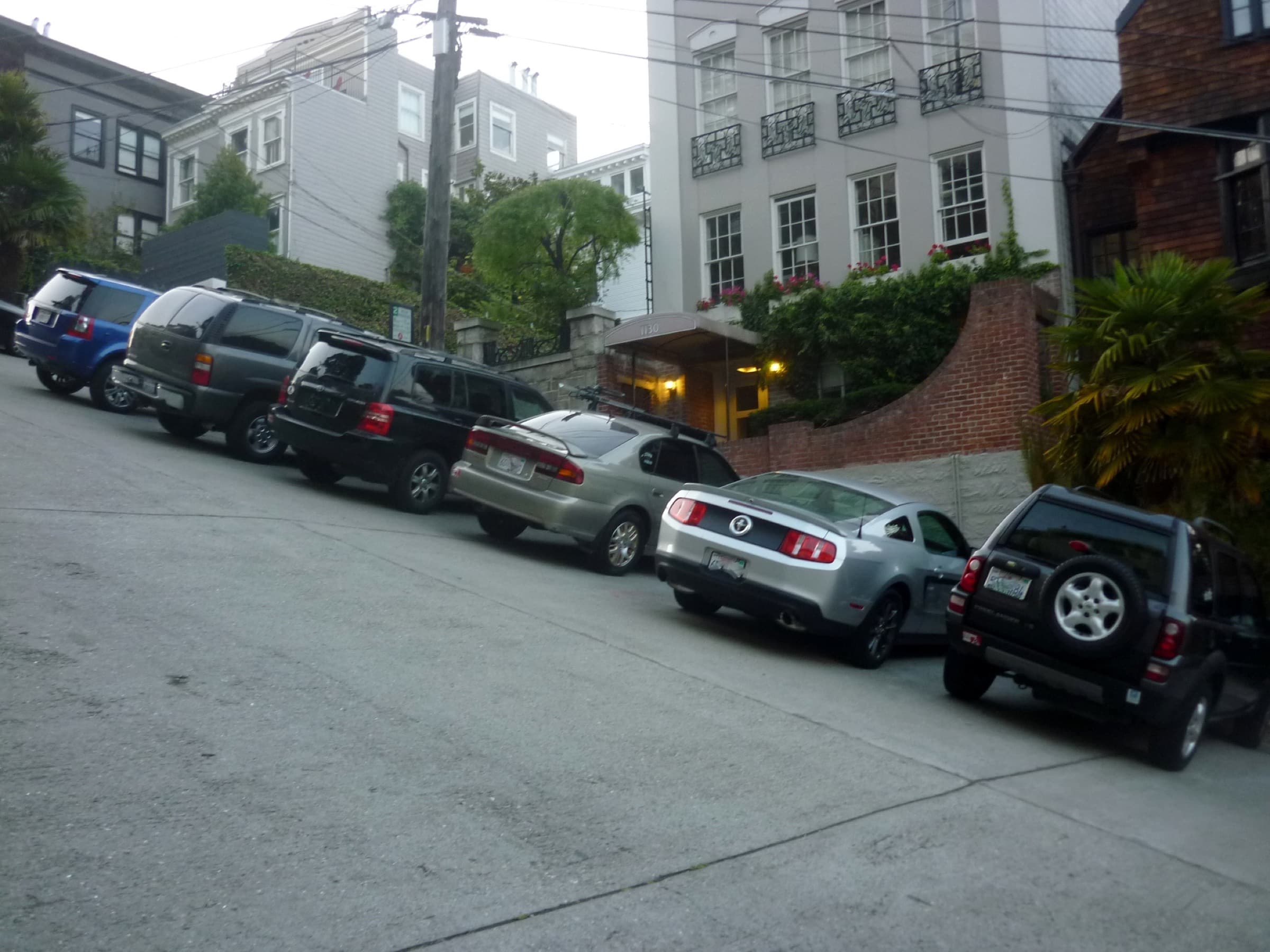
A San Francisco car purchase begins with the rectangle where the vehicle will spend the night. A residential parking permit can remove a posted neighborhood time limit, but it does not reserve a curb space. It also does not waive street cleaning, the statewide 72-hour limit, meters outside designated pay-or-permit blocks, color-curb restrictions, or commute-hour tow-away rules.
A deeded or rented garage removes part of that curb uncertainty. It introduces a different set of questions: whether the vehicle clears the door, ramp, gate, ceiling, and turning path; whether occupants can open the doors; whether a liftgate or roof box can operate; and whether a charger can legally and economically reach the assigned space.
Classify the storage arrangement before comparing cars: private garage controlled by the household, assigned condominium space, assigned rental space, mechanical stacker, shared unassigned garage, residential-permit curb parking, or unregulated curb parking. Each arrangement creates a different maximum vehicle size and charging plan.
Write down the trips the car would complete in an ordinary week. Include office days, children, relatives, groceries, medical appointments, bulky equipment, and regional weekends. A car that solves two difficult trips every day can justify meaningful storage cost. A car used twice a month competes with Muni, BART, delivery, taxis, carshare, and rentals while accumulating payment, insurance, registration, and parking expense.
The decision has three tests: where the car sleeps, what it repeatedly solves, and how it will be fueled or charged. Vehicle size and powertrain come afterward. Use the Car Affordability Calculator with twelve months of parking and insurance included, then use the Commute Cost Calculator only if a recurring regional trip is part of the ownership case.
The adult Muni monthly pass costs $86 in 2026. The Muni plus BART-within-San-Francisco product costs $104. Compare those figures with residential parking before adding a payment, insurance, registration, and energy. A paid garage can cost several times the transit pass each month, so parking should never hide in a generic lifestyle budget.
Permits, curb rules, garage fit, and charging approvals
SFMTA's annual passenger-vehicle residential permit costs $224 effective July 1, 2026. A motorcycle permit costs $112. Most eligible addresses may hold up to four active annual permits. Areas AA, EE, and HV are generally limited to one permit per driver and two per household, with a second permit for the same driver available only for a motorcycle. Limited waivers may cost more.
The vehicle must be registered and insured at the application address. A permit works only in its assigned area and exempts the vehicle from the posted residential time limit. It does not create a right to a space near the home, excuse street cleaning, authorize a color-curb use, waive a meter, or cancel a tow-away period.
Read parking signs up to 100 feet in both directions, inspect the curb color, confirm street-cleaning hours, look for commute-hour or temporary tow-away restrictions, and check daylighting near crosswalks. Park facing traffic and within 18 inches of the curb. On a grade of 3% or more, turn the wheels as required. A permit or disabled placard does not exempt a vehicle from the 72-hour maximum.
Once the street sweeper has physically passed the curb, SFMTA allows a vehicle to park there even when the posted sweeping window has not ended. On a block with a timed limit, moving a few feet may not reset the clock. SFMTA recommends moving to another block; the legal minimum is one block or one-tenth of a mile from the first recorded position.
Red curbs prohibit parking. Yellow, white, and green zones have defined uses and operating hours. Official driveway red zones are marked through the city process; privately painted curbs do not create the same restriction. Blocking a curb cut can lead to citation or towing. Effective July 2026, the SFMTA schedule lists a $335 first-time or $385 repeat administrative tow fee plus a $317 operating tow fee before storage and other charges.
Measure an older garage before placing a deposit. Record the narrowest opening, mirror-to-mirror width, body width with mirrors folded, ramp angle, sidewalk and threshold breakover, ceiling pipes and door hardware, turning space from the street, occupant door-opening room, liftgate clearance, and charger-cable route. Test the exact trim because wheels, mirrors, roof rails, and suspension can differ within one model line.
San Francisco's residential design guidance says garage openings in many neighborhoods commonly range from eight to twelve feet, while a standard curb cut has a ten-foot maximum. Those planning dimensions do not guarantee that an existing bay fits a modern car. A narrow street can demand a sharper approach, and a steep threshold can cause a long-wheelbase or low vehicle to scrape even when the door is wide enough.
For a mechanical stacker, obtain the written maximum length, width, height, and weight. Ask how it operates during an outage, who maintains it, and how long a disabled platform can remain unavailable. Roof boxes introduce another constraint: removable equipment may work when the household can store and install it safely, while permanent equipment can make an otherwise compact crossover too tall.
California Civil Code 1947.6 generally gives qualifying tenants a process to request an EV charger at an allotted parking space. Civil Code 4745 limits an HOA's ability to prohibit or unreasonably restrict charging in an owner's unit or designated space. These rights do not make installation free or eliminate engineering, permit, insurance, metering, and common-area responsibilities.
San Francisco's March 2025 EV charger checklist covers installations in existing parking facilities. Complete applications for projects with up to 25 chargers target review within 20 business days when no deficiencies are found; projects with 26 or more chargers have a longer target. Electrical work still requires permits and inspections.
Ownership patterns by storage and trip
San Francisco blocks vary sharply. These modules group recurring ownership decisions without assigning a crime level or guaranteed parking outcome to any neighborhood.
Mission renter with curb parking
A residential permit may remove the posted time limit, but space searches, street cleaning, and the 72-hour rule remain part of ownership.
- ·Compare a compact hybrid with no car plus transit and periodic rentals
- ·Public charging becomes a repeated errand when the lease has no dependable plug
- ·Choose exterior dimensions around curb and garage reality rather than occasional maximum cargo
Sunset or Richmond family with an older garage
A private garage improves overnight control while its door, ramp, and interior access can reject a vehicle that appears compact on paper.
- ·Measure mirrors, approach angle, liftgate clearance, and human exit space
- ·A compact two-row vehicle may serve daily family use better than a wider three-row
- ·Treat roof gear as a garage-height decision and rent for rare maximum-capacity trips
SoMa or Mission Bay condo owner
An assigned space can support an EV only after the HOA process, electrical route, capacity, metering, and cost are understood.
- ·Secure a durable charging agreement before choosing the powertrain
- ·Review common-area conduit, load management, permits, insurance, and successor obligations
- ·Use workplace charging as a supplement because employment and access policy can change
Reverse commuter to the Peninsula
Ownership can make sense when first- and last-mile gaps or work hours make Caltrain impractical, even for a household that uses Muni locally.
- ·Price garage and insurance here, then calculate tolls and energy in the commute-cost guide
- ·A compact hybrid handles uncertain charging; an EV works with dependable overnight access
- ·Test the weekly time saving rather than assuming a car always beats rail
Manage the risks without managing by fear
Vehicle theft
- ·SFPD counted 3,054 motor-vehicle thefts in 2025, down 44% from 2024
- ·Quote comprehensive insurance for the exact model, trim, and garaging ZIP
- ·Keep both keys secure and confirm immobilizer and recovery equipment on the exact trim
- ·Save the VIN, plate, policy details, and current photographs outside the vehicle
Theft from vehicles
- ·SFPD counted 5,380 thefts from vehicles in 2025, down 42% from 2024
- ·Keep the passenger compartment visibly empty and avoid using a cargo cover to advertise hidden property
- ·Secure overnight parking changes exposure but does not remove insurance or key-security needs
- ·Do not turn citywide totals into neighborhood or model rankings without direct evidence
Annual refresh
- ·Check residential permit, tow, administrative, citation, and meter fees every July
- ·Check demand-responsive meter prices and pay-or-permit expansion quarterly
- ·Refresh SFPD totals, Muni passes, utility programs, and charging law annually
Four San Francisco ownership tests
Mission renter, curb parking, no plug
The $224 residential permit does not guarantee a space, and public charging becomes a repeated task. Compare a compact hybrid with a no-car plan using transit, delivery, and periodic rentals. The useful decision is broader than EV range versus gasoline range.
Sunset family with an older garage
Measure the door, mirrors, ramp, turning path, occupant access, and liftgate before shopping. A compact two-row crossover or hatchback may handle weekly family duty more easily than a wide three-row vehicle. Rent a larger vehicle when the exceptional trip requires it.
SoMa condo owner with an assigned space
Review the HOA process, electrical route, panel capacity, metering, permits, insurance, and load management. An EV becomes defensible after the installation has a durable legal and financial path. Workplace charging should remain supplementary.
Reverse commuter to the Peninsula
Ownership may make sense when station access, the office's final mile, or work hours defeat Caltrain. Price the garage, insurance, and weekly time saving on this page. Calculate energy, tolls, and express lanes in the Bay Area commute-cost guide.
Renter and condo charging, step by step
A renter should establish that the lease includes an allotted space, who controls the wall and electrical route, whether a licensed electrician can complete the work, who pays for design and construction, how electricity will be measured, what insurance applies, and what happens when the tenancy ends. The statute contains exemptions and detailed conditions, so the article should link the law rather than promise approval in every building.
Long conduit runs, trenching, fire separation, and distance between the space and the unit meter can make a technically possible installation expensive. A landlord's agreement begins the project; it does not establish the final cost. Until approval and a written scope exist, compare the EV with an efficient hybrid. Public fast charging can cover trips and exceptions but adds time and price uncertainty when used as the weekly plan.
A condo owner should collect the governing documents, parking designation, architectural requirements, electrical plans, proposed common-area route, load calculation, metering method, contractor proposal, permit needs, insurance terms, and obligations that transfer to a later owner. Civil Code 4745 also creates a framework for certain common-area installations when an assigned space cannot reasonably be served, but the details deserve HOA and legal review.
A CEC-supported San Francisco study found that utility-scale grid capacity was generally available while building capacity varied. Many studied properties could support one or two 40-amp circuits; wider garage readiness could require major electrical upgrades. Larger and newer properties were generally more feasible because they more often had capacity, parking, and on-site management.
PG&E's former Multifamily Housing and Small Business EV Charger pilot is fully subscribed. EV Power Ready is a separate pathway supporting utility-side infrastructure for new, separately metered charging service; the customer remains responsible for chargers and downstream equipment. Program eligibility and cost should be confirmed before treating it as financial assistance.
What to carry into the showroom
Choose the smallest vehicle that handles the household's repeated hard trip. Parking control comes before powertrain. Reliable overnight charging can make an EV easy; uncertain charging favors a hybrid. A measured garage can support a crossover, while curb parking rewards compact dimensions.
Use a four-week inventory and mark every trip that genuinely becomes easier with a car. Price alternatives for the rest. Occasional rental expense can look high per day while remaining far below a year of fixed ownership. Verify current local carshare providers before naming one.
The final test is annual: would the household still choose the car after adding twelve months of parking, insurance, registration, energy, and time spent managing street rules? If the case depends on rare weekends, compare rentals before buying around the exception.
Related guides
- Northern California
- Bay Area Dealership Dossiers
- Honda of Serramonte Dossier
- Putnam Toyota Dossier
- Toyota Marin Dossier
- Marin Honda Dossier
- Bay Area Commute Costs
- Peninsula and South Bay Car Ownership
- Car Affordability Calculator
- Commute Cost Calculator
- Public vs Home Charging
- Hybrid vs EV Monthly Calculator
- Best EVs for Condo and Apartment Living
- Hybrid vs EV for City Drivers
- Charging at Condos and Apartments
- First Luxury Car Guide
- San Francisco to Lake Tahoe
More NorCal driving guides
East Bay & Contra Costa Car Ownership
A practical guide to car ownership from Oakland and Berkeley to Walnut Creek and Livermore, covering theft, insurance, BART parking, supercommutes, heat, and family needs.
Seasonal preparednessSeasonal Driving: Tahoe, Wildfire & Rain
Prepare a Northern California car for Tahoe chain controls, wildfire smoke and evacuation, atmospheric-river flooding, wet-weather tires, and realistic EV energy buffers.
Culture & motorsportNorthern California Car Culture
A respectful guide to Northern California's JDM, tuner, lowrider, custom, museum, and motorsport communities from the Bay Area and Sacramento to Sonoma and Monterey.
Culture & placeMonterey Peninsula Car Culture
Why classic-car culture rooted on the Monterey Peninsula - from Del Monte Forest road races and the first Concours to Laguna Seca, auctions, and Car Week - plus how to drive and visit the towns year-round.
Commute costsBay Area Commute Costs
Price a real Bay Area commute across bridge tolls, FasTrak, express lanes, fuel, parking, insurance, BART, Caltrain, and VTA.
Household planningPeninsula and South Bay Car Ownership
Match 101, 280, and 880 commute vectors with Caltrain, VTA, BART, charging control, and the right one-car or two-car household plan.