
Monterey Peninsula Car Culture: Concours Energy, Laguna Noise, and Year-Round Reality
Car Week did not land here by accident. Resort roads, a fatal forest race, a dry-lake track built in sixty days, and a concours that outgrew its side-show job turned a small peninsula into a global car calendar - and into everyday traffic for everyone who lives nearby.
Key numbers for Monterey Peninsula Car Culture
- Road races + Concours begin
- 1950
- Pebble Beach Road Races (Del Monte Trophy) and the first Concours d’Elegance start together - racing as the main event, the concours as a last-minute social add-on.
- Laguna Seca opens
- 1957
- Purpose-built track on a Fort Ord dry lake after Ernie McAfee’s 1956 fatal crash ends forest racing; SCRAMP builds a nine-turn course in about 60 days for roughly $125,000.
- Monterey County travel spend
- $3.3B
- See Monterey / Dean Runyan preliminary estimates for 2025 visitor spending - tourism is the industry frame that still underwrites the August surge.
- Car Week visitors
- 100,000+
- See Monterey has described Car Week drawing over 100,000 visitors, with the ten days accounting for more than 5% of annual hotel room nights.
- Pebble Beach Concours
- 75th edition
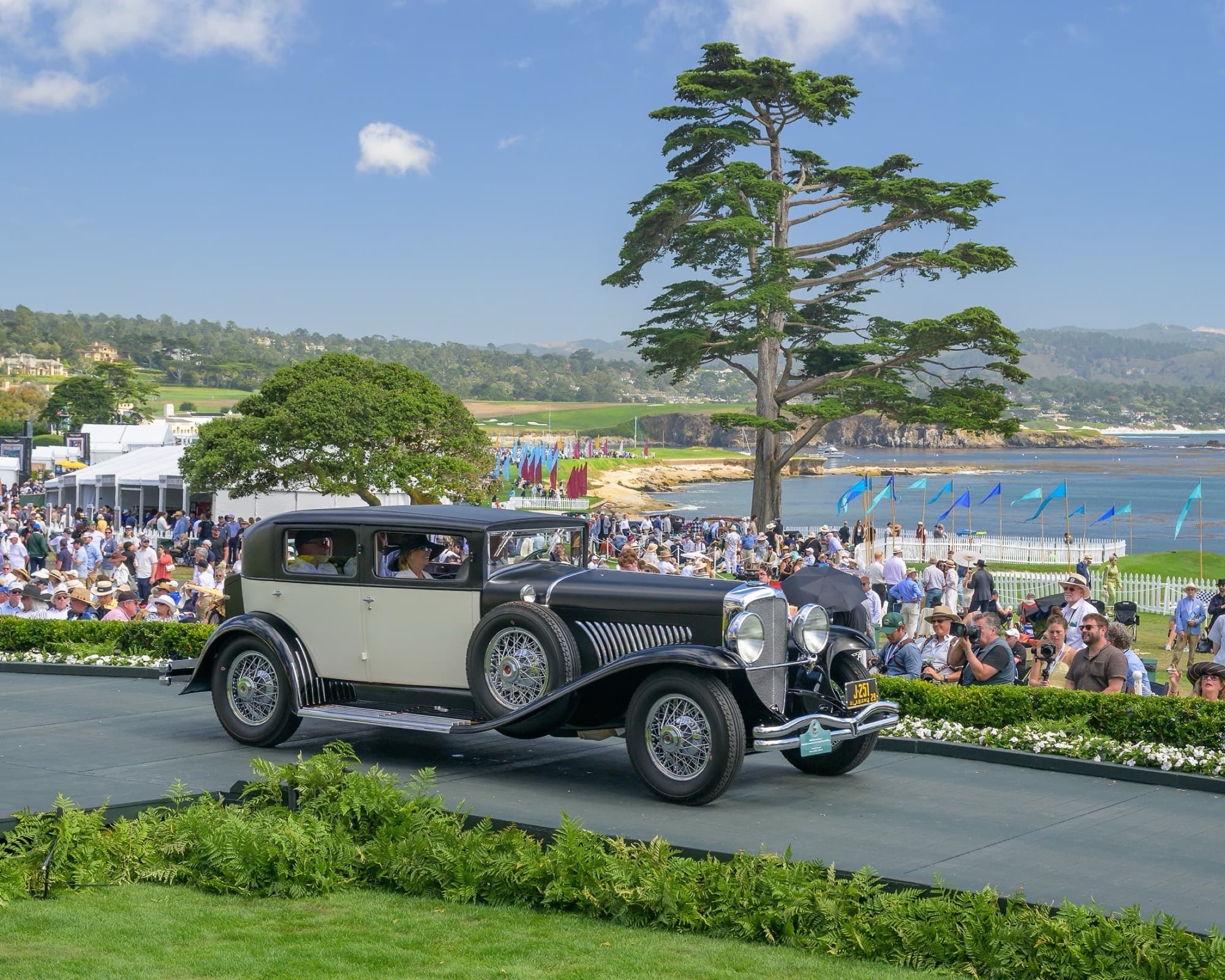
- Sunday, August 16, 2026 on the 18th fairway - the side show that stayed when the forest races moved inland.
- Laguna Seca layout
- 11 turns
- WeatherTech Raceway Laguna Seca’s current road course, including the Corkscrew - year-round motorsport successor to Del Monte Forest.
- Asian alone (county)
- 6.8%
- U.S. Census Bureau QuickFacts Asian alone share for Monterey County - audience context for visitors and residents, not a vehicle stereotype.
- 17-Mile Drive day fee
- $12.50
- Official Pebble Beach Resorts vehicle admission for day guests (reimbursable with qualifying resort restaurant spend); not Concours access.
Why car culture rooted here
The Monterey Peninsula did not invent American car culture. It did invent a West Coast stage where racing, resort wealth, and scenic roads could share the same weekend. Long before Car Week filled every hotel, the Hotel Del Monte era already treated automobiles as entertainment: a circular track in the 1890s and, according to peninsula historians, some of California’s earliest auto races on a horse-track layout between 1903 and 1907. The geography mattered then for the same reasons it matters now - moneyed visitors, dramatic coastline, and roads that feel like a destination rather than a commute.
Modern Monterey car culture begins in 1950. Sports-car racing was spreading from Europe into postwar America, and local organizers - including Sterling Edwards - wanted a real road race on the West Coast. After 17-Mile Drive proved unsuitable as a full circuit, they mapped a tight, tree-lined loop of Del Monte Forest roads near The Lodge at Pebble Beach. The first Del Monte Trophy races ran that year on a roughly 1.8-mile course (later stretched to about 2.1 miles), part pavement and part gravel, hemmed in by cypress. Phil Hill won the early racing headlines in a Jaguar XK120. Edwards took Best of Show at the brand-new concours with his Edwards R-26 Special.
The Pebble Beach Concours d’Elegance was not the main product in 1950. Concours historians are blunt: it was a last-minute social gathering meant to add style to the race weekend. Cars were shown nearby, then often paraded past the start-finish. Racing was the draw. The lawn was the party.
That hierarchy flipped because the forest could not keep up with horsepower. Crowds and cars grew through the mid-1950s. In 1956, Ernie McAfee fatally crashed his Ferrari into a tree on the narrow course. Organizers ended racing through Del Monte Forest. The Concours stayed on the golf links. The racing economy - already valuable to Monterey businesses - refused to die with the public-road layout.
In 1957, civic and business leaders formed what became the Sports Car Racing Association of the Monterey Peninsula (SCRAMP), leased dry-lake ground on then-Fort Ord, and built Laguna Seca Raceway in about sixty days for roughly $125,000. The first race weekend that November was billed as a continuation of the Pebble Beach nationals, now on a purpose-built nine-turn track in a natural bowl (“laguna seca” means dry lake). The Corkscrew and later eleven-turn layout turned a safety pivot into a permanent motorsport identity for the county.
With racing secured inland, the Concours matured into the collector institution Car Week orbits today. A key cultural turn came in 1955, when Phil Hill’s restored 1931 Pierce-Arrow took Best of Show - a signal, as Concours historians note, that the event was becoming a showcase for great collectible cars, not only new ones. Later organizers professionalized the selection and judging culture. Historic racing returned in force in the 1970s (Steve Earle’s Monterey gathering helping launch a broader historic-racing movement). Auction houses followed because buyers were already on the peninsula. The Quail, Concorso Italiano, club shows, and OEM concept lawns attached themselves over later decades. “Car Week” is the nickname for that accretion: there is still no single wristband, only a map of overlapping parties that share lodging, fog, and Highway 68.
So why here, still? Resort infrastructure and gated scenery give Concours theater a backdrop no convention hall can fake. Laguna Seca gives horsepower a legal home eight miles from the tourist core. San Francisco and Los Angeles sit close enough for a serious weekend and far enough that arriving feels like a pilgrimage. Asian American and Asian Canadian households often come as culture travelers - cameras, kids, marque curiosity - into a place that was built first for racers and resort guests. The dual map remains: postcard roads for visitors, grocery runs and race-weekend buffers for everyone who lives between Cannery Row and Carmel Valley.
Two calendars, one set of roads
Most of the year, peninsula driving is tourism, military-adjacent commuting, school runs, and Highway 1 weekend visitors. In early August, the same arterials absorb Concours shuttles, auction transporters, Laguna spectator traffic, and rental cars that do not know where Pacific Grove becomes Pebble Beach.
WeatherTech Raceway Laguna Seca sits east of the tourist core on Monterey–Salinas Highway (Highway 68). Reunion week and other major weekends turn that corridor into the hardest commute on the map. Build time even when Maps looks green.
Pebble Beach’s 17-Mile Drive is a private scenic road with an official day-guest fee and motorcycle prohibition. It is a coast product and a resort access system - not a free substitute for Concours tickets, and not the 1950 race course either. Gates and special-event hours change; verify before you promise elders a sunset loop.
Public transit will not replace a Car Week car for most visiting households, but downtown Monterey and Pacific Grove reward park-once walking once you are based. Carmel-by-the-Sea punishes circling. Seaside and Marina often trade charm for lodging availability during the surge. The 75th Concours year’s Road Racing Greats classes and Road Races poster art are not nostalgia decoration - they are the peninsula reminding visitors that the week began as forest noise, not as hospitality SKUs.
Peninsula places with different car jobs
These are overlapping towns on a small map. The car’s job changes every few miles.
Downtown Monterey & Cannery Row
Hotel density, aquarium tourism, Alvarado evenings, and the easiest place to feed a mixed group - crowded in August, still useful as a walkable base.
- ·Park once; do not chase street spots during Car Week
- ·Good for auction-week dinners and downtown kickoff energy
- ·Expect paid lots and visitor traffic year-round
Pacific Grove
Quieter coast living with Ocean View Boulevard, Asilomar, and Lighthouse Avenue food - often the calmest Car Week reset on the peninsula.
- ·Best break-drive base when Concours energy feels loud
- ·Watch motorcycle and bike traffic on the coast road
- ·Useful Supercharger access nearby at Country Club Gate
Carmel-by-the-Sea
Village walking, courtyard retail, and tight parking - charm that collapses if you treat it like a suburban shopping center.
- ·Park once and walk Ocean Avenue
- ·Book dinner before Car Week weekends
- ·Mission stop works when someone needs a non-car hour
Pebble Beach / Del Monte Forest
Resort gates, golf, and Concours Sunday geography. Living or lodging here is access and amenity; day driving is fee-managed scenery.
- ·17-Mile Drive fee is not a fairway ticket
- ·Concours week changes traffic and patience
- ·Destination charging helps overnight guests more than day-trippers
Seaside & Marina
Practical lodging and event overflow - Exotics on Broadway, Concours d’Lemons energy, and bases that trade postcard views for availability.
- ·Often the rational Car Week hotel strategy
- ·Plan Highway 1 / 68 timing to Laguna
- ·Good for households that prioritize sleep over ocean windows
Carmel Valley
Warm inland lunch and tasting-room pace - fog escape and Quail-adjacent geography without living on Ocean Avenue.
- ·Book ahead during Car Week
- ·One tasting plus lunch beats a rushed crawl
- ·Expect Quail Friday congestion near the Lodge
Two seasons that feel like different peninsulas
Car Week surge (early–mid August)
- ·Hotels, restaurants, and Highway 68 absorb a global collector calendar
- ·See Monterey has framed 100,000+ visitors and a material share of annual room nights
- ·Shorten daily ticket lists and protect one food-and-coast loop
- ·Residents plan around it - visitors should too
Quiet classic-car months
- ·September through early summer still offers 17-Mile Drive and Laguna weekends
- ·Carmel walking without Concours pricing
- ·Better for atmosphere seekers than auction theater
- ·Confirm raceway calendars rather than assuming August dates
- ·The same geography that hosted 1950 forest racing still rewards slow coast drives
Match the car to visitor week or resident week
Visitor who rents for Car Week
Choose easy parking and lodging charge honesty over a dramatic badge. A compact hybrid crossover covers short hops; skip wide trucks if Carmel lots are on the plan. Bring an EV only with a written overnight plug or disciplined DC stops. Do not stack Quail, Concours, and a Big Sur day.
Peninsula household near Laguna weekends
Year-round ownership still meets race traffic and tourist density. Keep a reliable daily that parks easily downtown, and add a second car only if commuting and major race weekends truly collide. Build Highway 68 buffers when the raceway calendar is loud.
Culture traveler without consignment money
You do not need a trailer to belong here. Reunion day passes, free Saturday shows, Pacific Grove dinners, and a 17-Mile Drive loop deliver the peninsula’s classic-car atmosphere without treating every hospitality chalet as mandatory.
Charging on a tourism peninsula
Public DC at Del Monte Center and Pacific Grove’s Country Club Gate helps visitors. Overnight plugs at hotels and short-term rentals decide whether an EV week feels calm.
Condo and HOA charging questions look like other California coastal markets: board rules, panel capacity, and assigned stalls. Car Week does not invent those problems - it only makes the week less forgiving when the plug fails.
What to carry into the showroom
The Monterey Peninsula’s car culture is a place with a specific origin story: forest racing that got too fast, a concours that refused to leave, and a dry-lake track built so the county would not lose the weekend economy.
Visit for the lawns if you want provenance theater. Stay for Pacific Grove evenings and Laguna noise if you want the year-round reason the map matters. Either way, protect a break drive - and do not confuse a gate fee with a Concours ticket, or a hospitality chalet with the Del Monte Trophy roads that started it all.
Related guides
More NorCal driving guides
East Bay & Contra Costa Car Ownership
A practical guide to car ownership from Oakland and Berkeley to Walnut Creek and Livermore, covering theft, insurance, BART parking, supercommutes, heat, and family needs.
Seasonal preparednessSeasonal Driving: Tahoe, Wildfire & Rain
Prepare a Northern California car for Tahoe chain controls, wildfire smoke and evacuation, atmospheric-river flooding, wet-weather tires, and realistic EV energy buffers.
Culture & motorsportNorthern California Car Culture
A respectful guide to Northern California's JDM, tuner, lowrider, custom, museum, and motorsport communities from the Bay Area and Sacramento to Sonoma and Monterey.
Commute costsBay Area Commute Costs
Price a real Bay Area commute across bridge tolls, FasTrak, express lanes, fuel, parking, insurance, BART, Caltrain, and VTA.
City ownershipSan Francisco Car Ownership
Decide whether a car earns its space in San Francisco through parking permits, garage fit, street rules, theft exposure, insurance, and charging.
Household planningPeninsula and South Bay Car Ownership
Match 101, 280, and 880 commute vectors with Caltrain, VTA, BART, charging control, and the right one-car or two-car household plan.