Waymo Wants to Scale the Car. Zoox Wants to Kill the Cockpit. Vegas Has Both.
On the Las Vegas Strip, Alphabet's Waymo and Amazon's Zoox now chase the same riders with opposite theories of the car. One looks familiar on purpose. The other removed the steering wheel and asked Washington for permission.
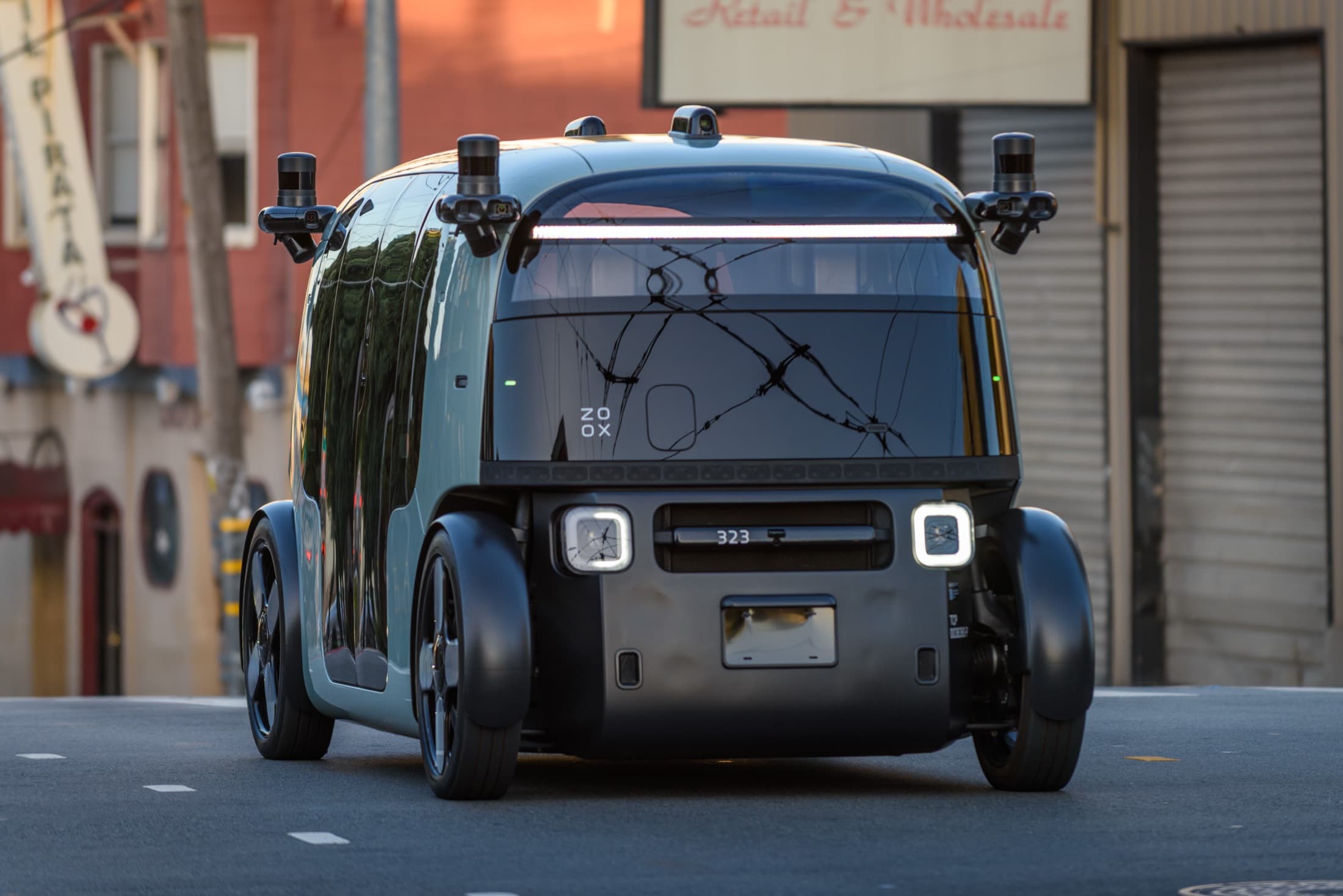
LAS VEGAS — Stand on Las Vegas Boulevard long enough and you will see two versions of the future pass each other. One looks like a tall electric minivan with sensors on the roof. The other looks like a teal carriage that forgot which end is the front. Both have nobody in the driver's seat. Both will take your money.
That overlap is new. Amazon-owned Zoox started charging on the Strip on August 10, after NHTSA gave it a rare commercial exemption for vehicles with no steering wheel or pedals. Waymo, Alphabet's autonomous unit, followed in mid-September with paid rides in its newer Ojai minivans, still limited to invited riders as the waitlist clears. The same corridor that used to be a taxi and Uber fight is now a live test of what Americans accept when the human driver is gone.
City-count scoreboards miss the real split. The fight is product philosophy.
Waymo's bet is to put autonomy into something that still reads as a car. The Jaguar I-Pace did that work for years. The Ojai, now common in Texas and rolling through Vegas, is a roomier minivan on a Zeekr platform from China's Geely group, finished with Waymo's sixth-generation Driver in Mesa, Arizona. Sliding doors, big screens, Google's Gemini as a cabin helper: designed to be hailed without a lecture.
Late September reporting put Waymo around 4,000 robotaxis and about 500,000 paid rides a week across 15 U.S. cities. Most of that metal still sits in California and Texas.
Zoox's bet is stranger. The company designed a vehicle around riders, not drivers: seats facing each other, bidirectional driving, no cockpit. To charge for that in America, it needed federal permission to skip safety standards written for cars with human controls. NHTSA's July grant allows up to 2,500 exempted Zoox vehicles a year for two years.
In San Francisco, selected riders still ride free. California has not cleared Zoox to collect fares yet. The fleet that bills people is a fraction of Waymo's. The cabin is the point.
The parent companies sharpen those theories. Alphabet grew up on maps and software that wants to be everywhere, so Waymo scales like a network: more cities, vehicles normal enough to ignore, Uber partnerships in some markets.
Amazon grew up on warehouses and last-mile logistics. Zoox builds the pod the way Amazon builds a fulfillment center: purpose-built, odd until it works, optimized for the trip rather than the driver's ego.
There is a China twist inside Waymo's scale story. The Ojai's body comes from a Chinese EV maker Americans cannot easily buy as a consumer car. Zeekr ships unfinished base vehicles without Chinese connected systems; Waymo installs its own stack in Arizona. Tariffs still raise the cost of every unit, and the company appears willing to pay that tax to grow. Zoox builds in Hayward, California, and fights a different bureaucracy: prove a car without a wheel is safe enough to sell rides.
Neither company has solved the airport curb that actually decides a Vegas trip. Nevada's August permits cleared thousands of robotaxi slots for Tesla, Waymo, and Uber's network partners, as we reported then. Harry Reid International still needs separate aviation approval for pickups. Waymo's early Vegas map skipped freeways and the airport. The Strip is a demo. The terminal is the business.
For Asian American households in the Bay Area, this is already less sci-fi than it sounds. Waymo's white cars are part of the Mission and SoMa street furniture. Zoox pods still turn heads because they look like the future from keynotes. On a Los Angeles to Las Vegas weekend, the question is practical: which app, which fare, which zone covers your hotel. Our corridor guide still assumes you might drive. The Strip no longer assumes a human will.
Watch what people choose when both options sit in the same geofence. A familiar minivan that pretends the twentieth century still exists, or a cockpit-free box that makes you sit face to face with strangers. That choice is the investigation. The rest is fleet size.