
At 75, Pebble Beach Returns to the Road Races That Created It
The Concours began as a side attraction to a forest road race in 1950. Its 75th edition brought 22 of those early racers back, including both MG specials that helped launch Ken Miles.
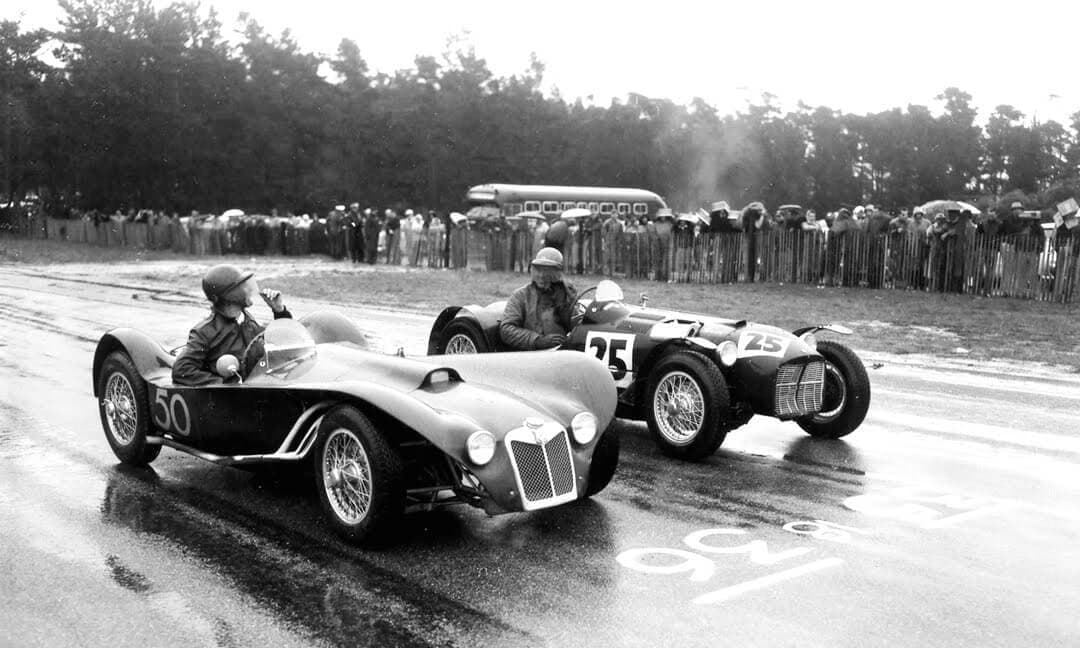
PEBBLE BEACH — Before Pebble Beach became shorthand for polished classics on clipped grass, it was a road race through Del Monte Forest. The first Concours was the side attraction.
The 75th Pebble Beach Concours brought that origin story back to the 18th fairway Sunday. Twenty-two cars from the original road-racing era appeared in two special classes, split between near-original factory racers and the homebuilt specials that defined early West Coast sports-car competition.
The first race and Concours shared a weekend in November 1950. Concours cars were judged in a field near the tennis courts, then paraded past the race start. Chairman Sandra Button has described the show as a last-minute social gathering intended to add style to the main event.
Sterling Edwards conceived the road race and entered his new R-26 Special Sport Roadster hoping to win it. A young Phil Hill took the first Pebble Beach Cup in a Jaguar XK120 instead. Edwards went home with Best of Show, giving the event its first two winners and two very different definitions of a great car.
The forest circuit helped launch Hill, who became America’s first Formula 1 world champion, and gave California builders a proving ground for their own specials. It also gave Ken Miles a place to show that he could develop a car as effectively as he could drive one.
Both of Miles’s MG-based specials returned Sunday. R1 arrived in 1953 with a narrow body over a steel-tube frame and dominated the under-1500-cc field. It accumulated 12 victories before a failed engine ended its career at Pebble Beach in 1954.
R2 was lower, lighter-looking and stranger. Designer Robert Cumberford wrapped a streamlined body around a one-inch tube frame and a heavily modified 1,466-cc MG TF engine. Its flat profile earned the nickname “Flying Shingle.” In 1955, Miles drove it to the Pebble Beach Cup for modified cars under 1500 cc and third overall in the main race.
R1 and R2 show what club racing once allowed: a gifted mechanic and driver could rework familiar British hardware into something fast enough to trouble larger machinery. The cars carry fabrication choices and race damage that a concours judge can read as clearly as hand-shaped coachwork.
The old course could not survive rising speeds. Ernie McAfee’s fatal crash in 1956 ended racing on the tight, tree-lined roads, and Laguna Seca opened inland in 1957. The move separated the race from the Concours, but it also gave the Monterey Peninsula the two institutions that still anchor Car Week.
Sunday’s display stitched them together again. The road racers came to the lawn after a larger group had run at the Rolex Monterey Motorsports Reunion, letting spectators hear the machinery before seeing it judged. Pebble also made room for Japanese endurance cars in a first full class, another reminder that competition history belongs beside traditional elegance.
The 75th field still honored Ferrari, Vignale coachwork and the prewar forms most people picture when they hear “Pebble Beach.” The road-racing classes supplied the grease under the fingernails. They explained why this event exists on this particular stretch of California coast.
Use our Pebble Beach Concours event page for the full 75th-edition context, then read the Monterey Peninsula car-culture guide for the road from Del Monte Forest to Laguna Seca. Our Monterey Car Week guide connects the rest of the weekend.
Best of Show owns the final headline. The returning road racers explain how the show got here.