
Pebble Beach Still Crowns the Past. Asian Automakers Are Competing for the Future.
A Clark Gable Duesenberg took Best of Show at the 75th Concours. Down the fairway, Japanese race cars finally got a judged class of their own, while Acura unveiled its next design language at The Quail.
PEBBLE BEACH — Sunday’s Best of Show went to a car that already had a legend attached. Harry Yeaggy’s 1935 Duesenberg SSJ Special Speedster did not have to invent a story for the judges.
One of two short-wheelbase, supercharged SSJs, the black roadster spent its early life with Clark Gable and more than 60 years with one family before Yeaggy bought it three years ago. Fresh black lacquer over light saddle leather gave Duesenberg an eighth Best of Show, more than any other American marque.
That result tracks how Pebble works. Class judges start with originality and authenticity: was the car preserved or restored the way it left the shop? Honorary judges weigh elegance. Only class winners reach the final vote, and history travels with the car as much as paint does.
The SSJ arrived with every credential. The other nominees were a 1938 Delahaye and two 1950s Ferraris. The final group was broader than a pure prewar contest, but it was still about hand-built rarity and a paper trail you can defend.
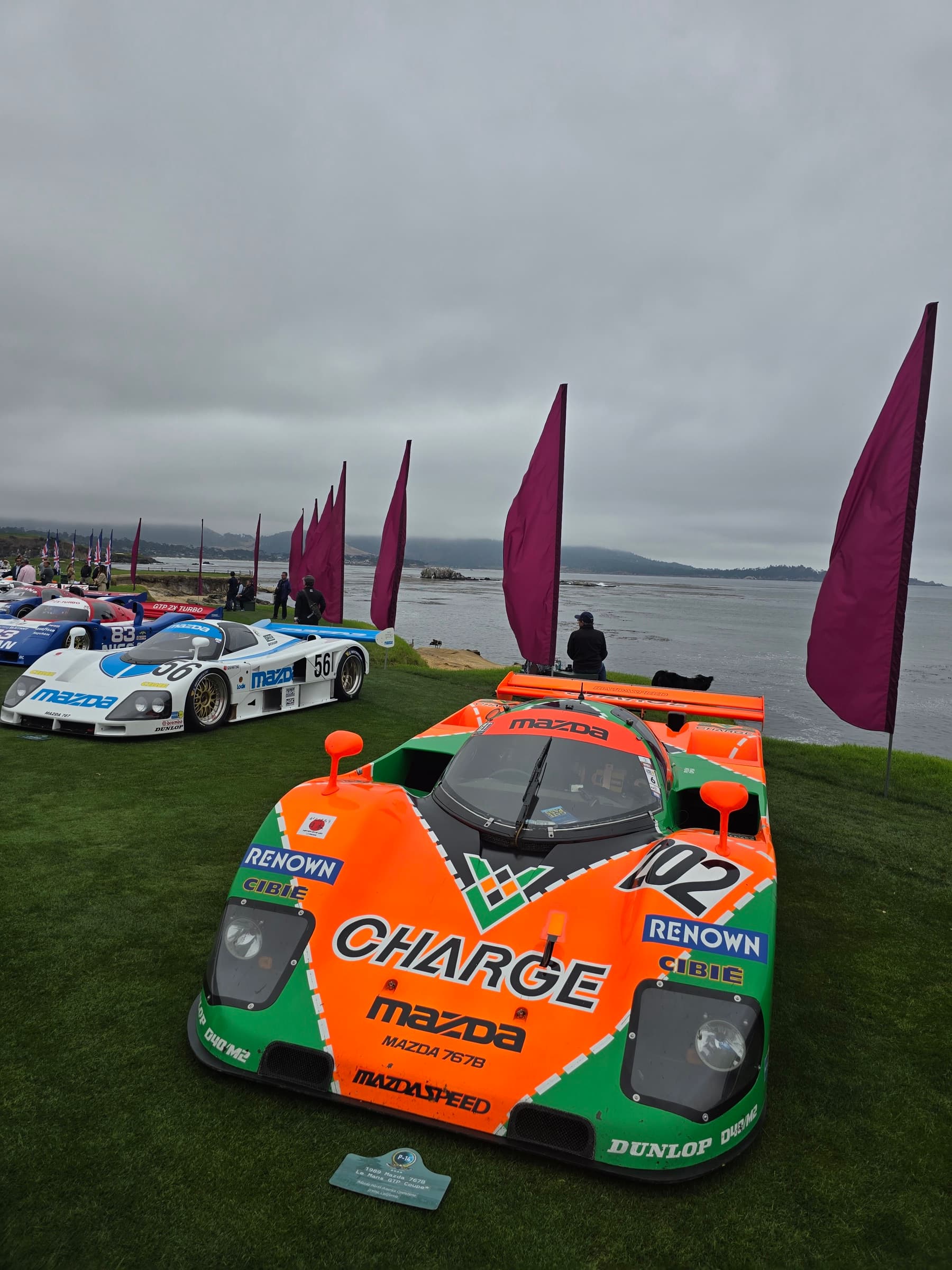
A few rows down the 18th fairway, another history finally got the same kind of invitation. “Japanese Motorsports: The Rising Sun at Speed” was Pebble Beach’s first full judged class for Japanese cars. A Toyota 2000GT had appeared as an entrant in 1968. It took another 58 years to assemble a class around what Japan accomplished in international racing.
Our photograph catches the Charge Renown Mazda 767B on that lawn, orange and green against the Pacific. Around it sat endurance machinery from Toyota, Honda and Nissan, cars shaped more by pit strategy and airflow than by a coachbuilder’s pencil. First in class went to a 1985 Toyota 85C L Longtail, then a 2010 Honda HPD ARX-01c and a 1990 Toyota Eagle HF89.
None of them reached the Best of Show nominees. The top prize still follows the classes the Concours creates, then the archives, restorations and owners who can supply a winning example. Japanese racing history finally had that route this year. The Best of Show ballot is the next climb.
Asian automakers have also learned to use Pebble’s other lawn, where concepts are shown rather than judged. Acura unveiled its NEXERA Vision coupe at The Quail on Friday, then parked it on Sunday’s Concept Lawn. The hidden lighting and low body won’t reach production as shown. Acura says the design language will, beginning with the next RDX Hybrid.
Car Week has been this kind of stage for years. Acura has brought future design studies to Monterey before. Lexus used The Quail and the Concept Lawn for its Sport Concept in 2025, later renamed the electric LFA Concept. Genesis brought the Essentia through Car Week in 2018 and placed the Genesis X on the Concept Lawn in 2021. Without a century of coachbuilt ancestors on the books, these brands show the audience what they want collectors to value next.
The gap between the concours lawn and the concept lawn looks wider than it is. The Duesenberg once stood for the most advanced American performance car money could buy. Today’s prototypes are trying to become tomorrow’s provenance. Press releases and dramatic doors are only the opening chapter. The history still has to happen.
If you want the selection and judging work behind the ribbon, start with our concours-worthy guide. The 75th Concours road-racing story follows the competition history that started the event, and our Monterey Peninsula guide connects the lawn to the rest of Car Week.
An Asian-built car won’t win Best of Show just because the calendar feels overdue. A 787B, a Toyota 2000GT, a first-generation NSX and other serious candidates still have to clear the same gate as the SSJ. Pebble Beach opened that gate wider this year. What rolls through it next is now part of the competition.