
The Electric Lexus LFA Finally Moves at Goodwood
Lexus quietly moved its battery-electric LFA Concept from the Supercar Paddock to Goodwood's hill, giving the project its first public dynamic runs while leaving the production details under camouflage.
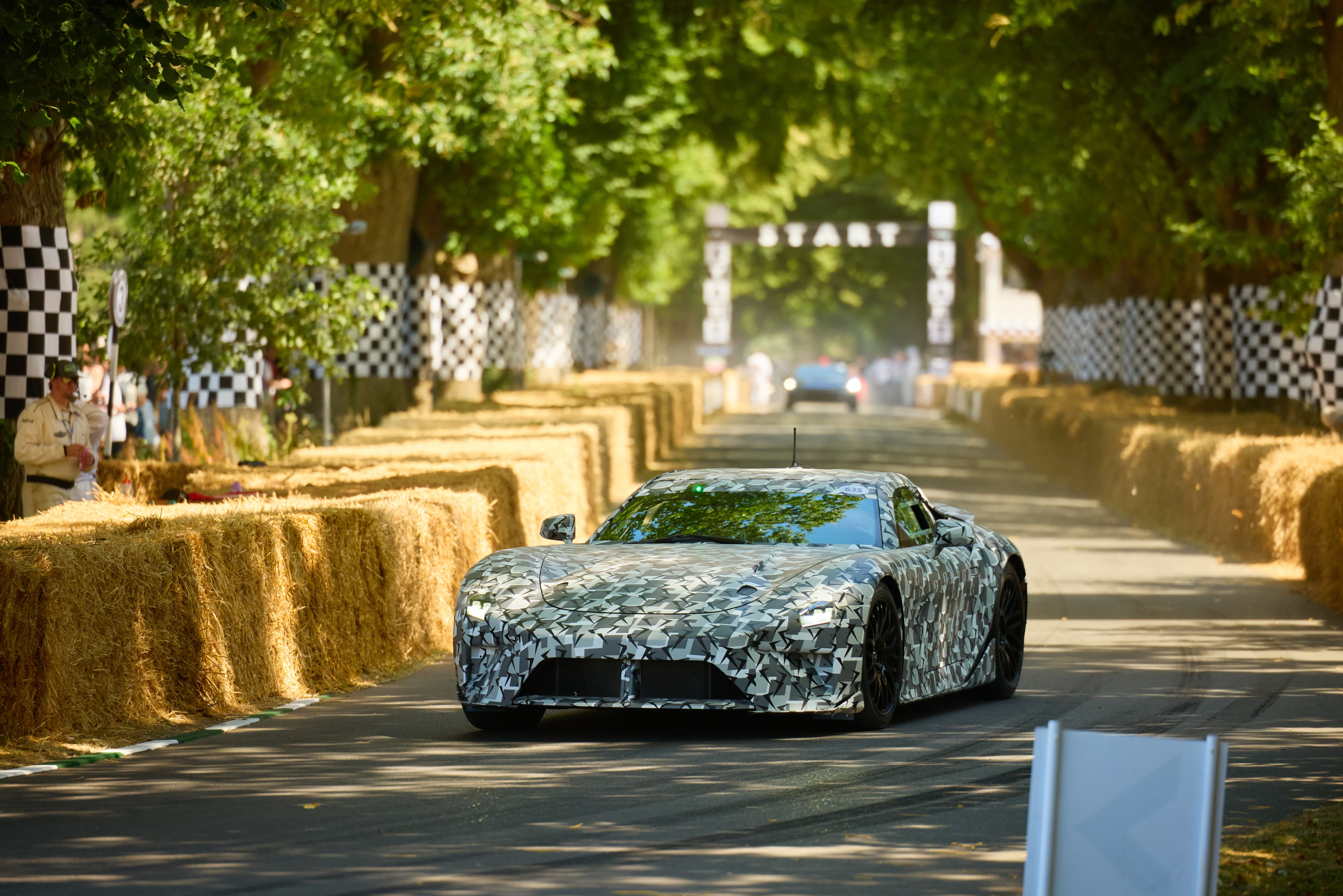
The Lexus LFA Concept arrived at the 2026 Goodwood Festival of Speed with a modest assignment: sit in the Supercar Paddock and let visitors study Lexus's electric halo-car idea. Then the camouflaged prototype joined the high-speed sessions. From July 9 through 12, it made the project's first public dynamic runs alongside Toyota's GR GT and GR GT3.
Lexus announced the surprise on July 15, three days after the festival closed. The car first shown as the Lexus Sport Concept at Monterey Car Week in 2025 has now crossed an important line. It can run in public, at speed, on a course that exposes more than studio lighting ever could.
The appearance also clarified how the project relates to Toyota's two new GR flagships. Lexus confirms that the LFA Concept uses a light, high-rigidity aluminum body frame based on the GR GT's structure. The three programs share a 2,725-millimeter wheelbase, a low driving position, and development priorities centered on rigidity, aerodynamics, and a low center of gravity.
Their powertrains then split sharply. The GR GT uses a 4.0-liter twin-turbo V8 hybrid. The GR GT3 adapts the architecture for customer racing. The LFA explores the same engineering foundation as a two-seat battery-electric sports car. Goodwood turned Toyota's multipath strategy into one photograph: hybrid road performance, combustion-powered racing, and a BEV halo project on the same hill.
Lexus identified six drivers across the festival program: Elfyn Evans, Kazuki Nakajima, Hiroaki Ishiura, Sho Tsuboi, Yuichi Nakayama, and Uwe Kleen. Its release does not match every driver to every LFA run, although it names Ishiura as a development driver for all three programs. That caveat matters when clips circulate without reliable captions.
The name has history here. Lexus says the original V10 LFA first appeared at Goodwood in prototype form in 2009. Race-prepared versions later became familiar hill-climb visitors, and a production road car ran in 2013. Seventeen years after that first prototype visit, the electric concept returned with a harder brief: preserve emotional credibility after losing one of the most celebrated engines ever put in a production car.
Project General Manager Yukihiro Yukita says the team is pursuing a multisensory experience built around immersion and lasting resonance. In a separate Autocar interview, he said Lexus wants to redesign useful sound and vibration around electric response instead of copying an engine note or gearbox. Designer Shogo Kasamatsu told the publication that the design is almost representative of the finished car and referred to a planned 2027 launch.
Those comments move the conversation forward, but Lexus still formally calls the vehicle a concept. The company has not announced production approval, battery chemistry, motor count, output, range, acceleration, price, or North American availability. Reports about solid-state batteries remain reports. The attractive numbers attached to older Lexus electric concepts should not be reassigned to this prototype without confirmation.
North American interest is reasonable. The design debuted in California, and Lexus's U.S. and Canadian newsrooms have both covered the concept. A small-volume electric LFA could shape the brand's performance reputation well beyond its sales total. Buyers comparing today's practical choices can use our hybrid versus EV guide and monthly cost calculator; the LFA belongs to a more emotional corner of the same powertrain debate.
Goodwood supplied the clearest proof yet that the electric LFA program runs. The next milestone will be less theatrical and more demanding: firm specifications, market plans, and a production commitment.