How Linda Zhang Made Ford's Electric Pickup Believable
The Chinese American engineer who led the F-150 Lightning did not remake Ford. She made America's default work truck electric without asking buyers to leave the nameplate they already trusted.
DEARBORN — Ford became believable as an EV company the day an electric F-150 stopped being a concept joke and started getting reserved by the hundred thousand.
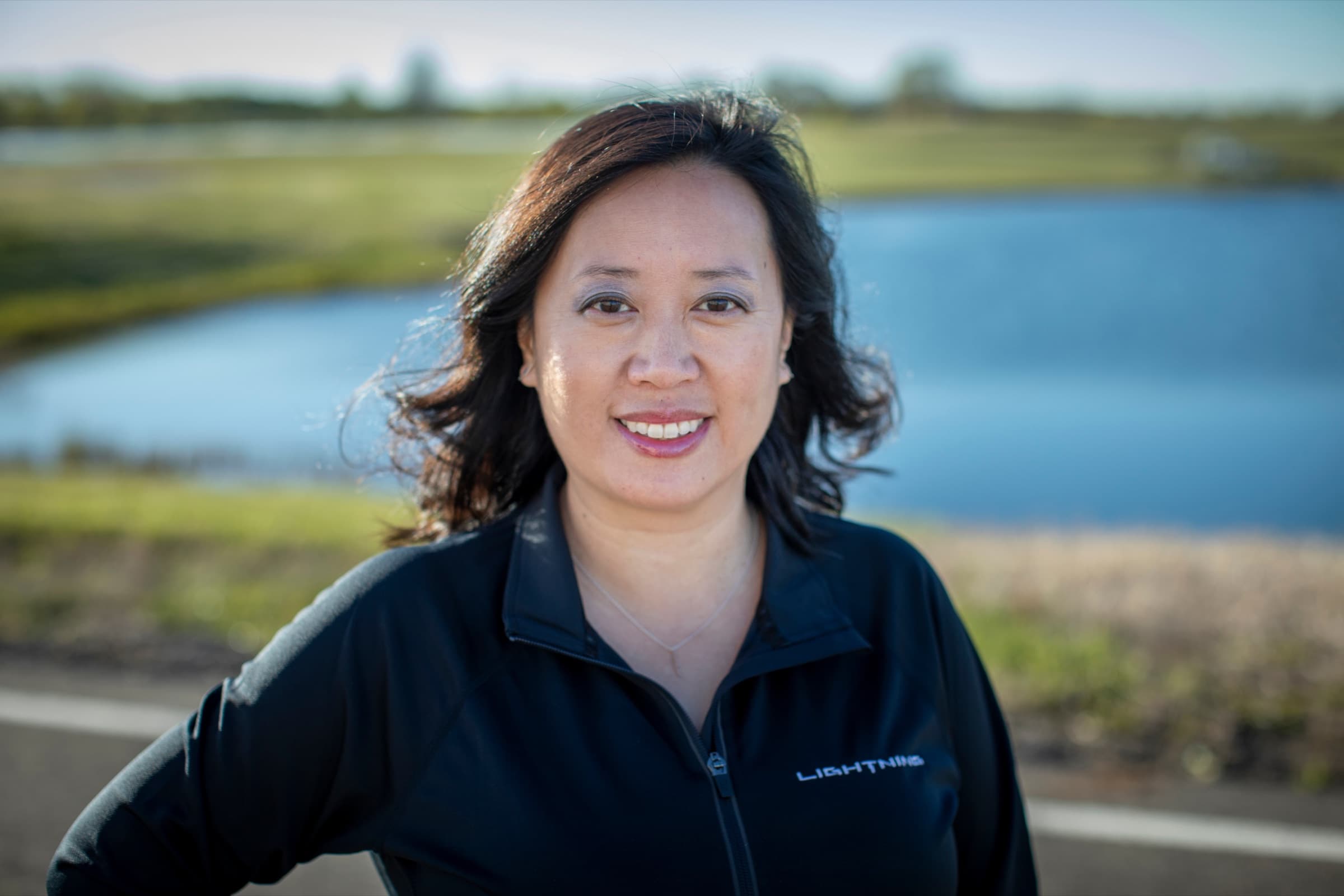
That shift has a nameplate engineer. Linda Zhang, a Chinese American University of Michigan graduate who joined Ford out of undergrad in the mid-1990s, took the Lightning assignment in September 2018 and rode it through reveal, plant build-out, and Job 1. She later moved into Director, EV Programs. The Lightning chapter is still the one that changed the argument around the Blue Oval.
Electrifying the F-Series was never a niche crossover problem. A 2021 Michigan Ross alumni profile put 2019 F-Series revenue above $42 billion. Hand that franchise an electric twin and you are asking contractors and suburban parents to trust a battery with the truck that already sits in the driveway.
Zhang's own biography made the assignment less abstract. TIME reported that her father, a Chinese immigrant, had researched transmissions for Ford. She started at Michigan as a 16-year-old first-year, finished electrical engineering, added a Dearborn computer-engineering master's, then an MBA.
College Graduate rotations put her through manufacturing, product development, finance, and strategy. She had already worked Explorer, Escape, and gas F-150 programs before Lightning.
The brief was blunt. Do not bolt a battery into an F-150 costume. Zhang told interviewers the team had to keep truck utility and use the electric layout for things gas trucks do less cleanly: frunk storage, mobile power, and a launch that made skeptics quiet.
President Joe Biden's "This sucker's quick" line after a 2021 test drive was theater. Truck culture listens to torque.
The factory mattered as much as the press kit. Ford built the Rouge Electric Vehicle Center in Dearborn on an old assembly site Zhang remembered from earlier plant work. University of Michigan Engineering put the building at about 506,000 square feet.
Job 1 landed April 26, 2022. Zhang's launch-day line, carried in Ford materials, was the plain version: not every day do you launch a truck that changes how Americans feel about electric vehicles.
Demand arrived before the first retail handoff. TIME cited about 150,000 Lightning reservations by October 2021. Those deposits were not the same as sustained sales, but they proved the taboo had cracked: households that would never shop a Tesla truck were willing to put money on an electric F-150 that still looked like an F-150.
None of this turned Ford into Tesla. Lightning sales still live in the tens of thousands. Ford's U.S. figures put the truck at 24,165 units in 2023 and 33,510 in 2024, with total Ford EV sales in the United States around 97,865 that year.
Zhang's program proved something narrower and more useful. Ford could put an EV badge on the vehicle Americans already trusted for work and towing. In January 2023 the Lightning took North American Truck of the Year, and Zhang accepted for the team.
For Asian American readers, her path is a reminder that Ford's hardest EV programs have included engineers who grew up between immigrant households and Big Three plants. S&P registration cuts still show Asian American buyers over-indexing on EVs and hybrids and under-indexing on full-size pickups. Lightning did not flip that. It changed the dinner-table argument anyway.
Zhang is no longer only the Lightning chief engineer on a business card. Director, EV Programs is the quieter title after the TIME cover. Ford's modern EV credibility with truck households still runs through the program she led.
If you are comparing a Lightning, a gas F-150 PowerBoost, or a crossover EV and you want to stay in Blue Oval service lanes, start with the hybrid versus EV monthly calculator.
Ford did not invent the electric pickup in a vacuum. Zhang's team made the electric F-150 feel inevitable enough that the skeptics had to drive it before they finished the joke.